


April 26, 2024
From Canopy to Currents: Exploring the Forest-Water Connection
Even when reforestation is successful, managed forests are not equal to natural forests when it…



For the well-being of all living things, Alberta has healthy, natural ecosystems in its river headwaters.
There is plentiful clean water for all Albertans; province-wide awareness and stewardship of water as a precious, life-giving resource; and effective, ecosystem-based management of Alberta’s watersheds, groundwater, river valleys, lakes, and wetlands.
Water sustains life. It is critical for our food, sanitation, industry, recreation, and solace. Indeed, water has become a symbol of the health and vitality of both humans and ecosystems. In its many forms, it is also a significant symbol of Canada, pervading our visual art and literature.
Since AWA’s beginnings in the 1960s, we have focused on the health of Alberta’s watersheds, wild rivers, and wetlands, which we consider integral to the maintenance and well-being of all Albertans, including wildlife. We recognize that education, protection, and regulated management and use are the most democratic and efficient means of securing long-term water quality and of conserving aquatic ecosystems and their biological diversity.
Water relies on healthy ecosystems to remain clean, pure, and available. Protecting watersheds, wetlands, and wild, natural rivers is the cheapest and easiest way to provide clean, safe water, as well as many other benefits, including wildlife habitat, flood control, sanitation, and places for healthy forms of recreation.
Kinnaird Lake, Lakeland Provincial Park
With each passing year, water events like prolonged droughts and declining river flows, shrinking glaciers and increased flooding are increasing our awareness of the importance of water. Yet the multitude of threats that impact our water quality and quantity are increasing dramatically. Very few of Alberta’s watersheds remain intact. Our watersheds are being degraded at an alarming rate by activities such as forestry, mining, oil and gas development, cattle grazing, residential sprawl, and off-road vehicle use. But we, and our governments, are doing very little to conserve and protect this precious resource.
When conflicts arise, government decisions do not reflect what is needed to maintain healthy watersheds. Water quantity and quality, it seems, is not a high priority. If we are to protect and preserve our water heritage, this must change, and change quickly.
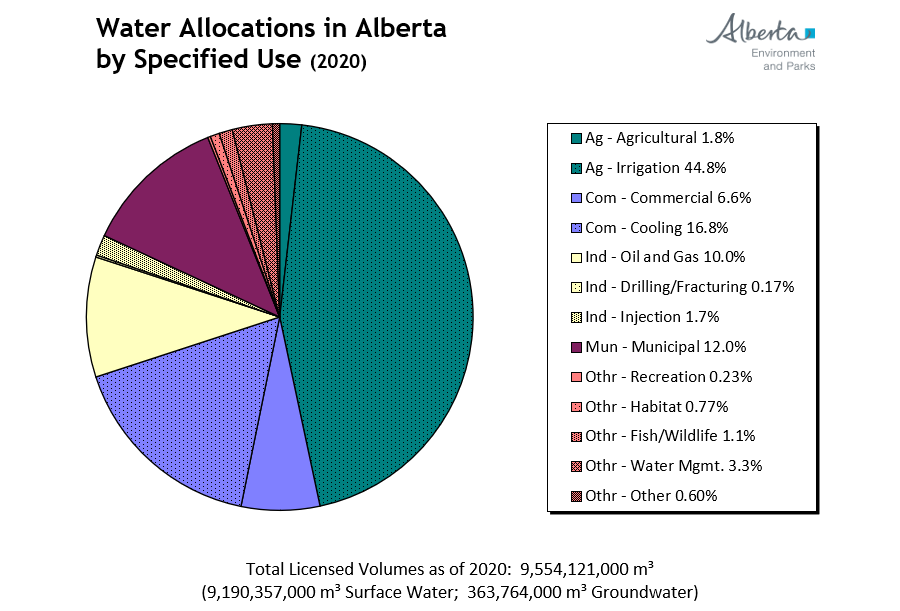
Figure 1: Water Allocations in Alberta by Specific Purpose (2020). c/o Alberta Environment and Protected Areas Water Policy Division.
According to the most recently available provincial data, Alberta has allocated over 9.5 billion cubic metres for use annually in the province (Figure 1). The agricultural sector, more specifically the 12 irrigation districts, hold the majority of water allocations (46.6%) in Alberta and have the oldest water licenses. This is meaningful, as under the province’s ‘First in Time, First in Right’ legislation, the most senior licenses are permitted to withdraw the entirety of their allocation first, regardless of purpose.
The proportion of water allocated is different from the volume of water actually used annually for each purpose. For example, in 2022, 1.6 billion cubic meters of water was used to irrigate in Alberta, consuming 17 % of the province’s total allocations. The volume allocated can be understood as the maximum amount of water available to use in a given year.
Water for commercial and cooling purposes (23.4%), municipalities (12.0%), and oil, gas, and other related industries (11.9%) make up the bulk of the remaining allocations (Figure 1). Altogether, water for the purposes of habitat, fish and wildlife, and water management receive just over 5% of all allocations.
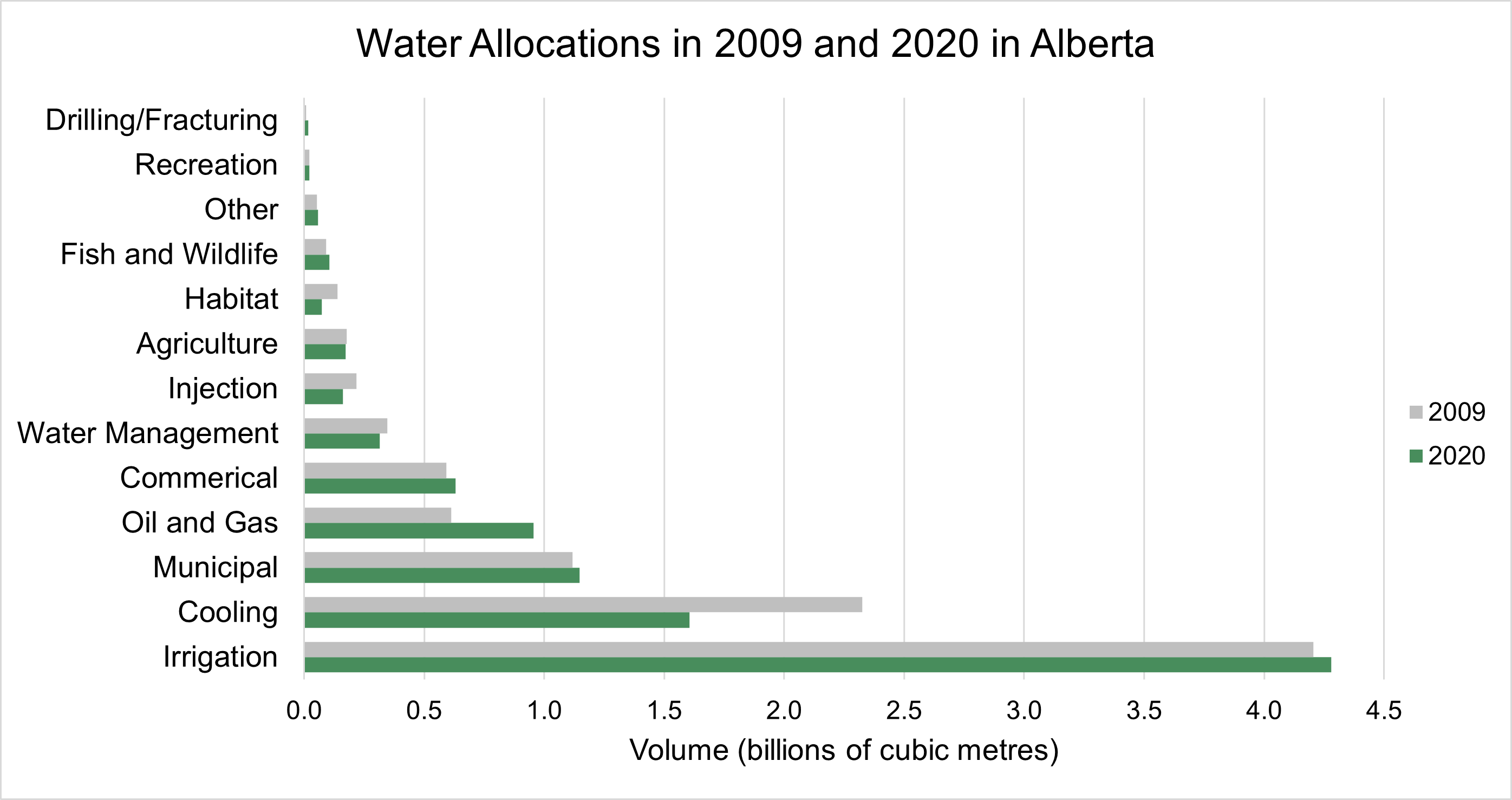
Figure 2: Water Allocations in 2009 and 2020 in Alberta. Based on data provided by Alberta Environment and Protected Areas Water Policy Division.
As of 2023 almost 4.3 billion cubic metres of water is allocated for irrigation (Figure 2). The next largest licensees are cooling with 1.6, municipalities with 1.1, and oil and gas with 0.9 billion cubic metres of allocations.
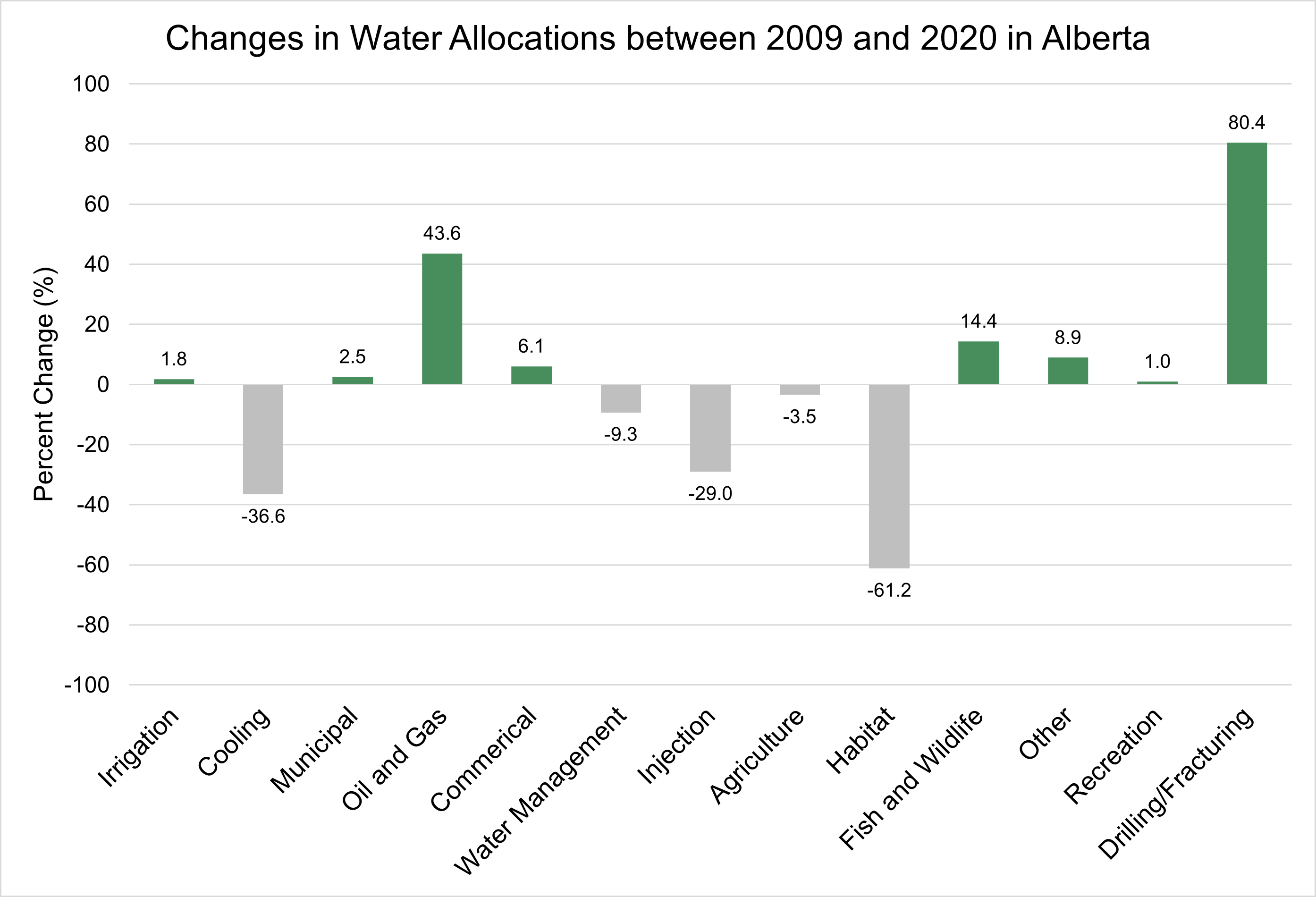
Figure 3: Changes in Water Allocations between 2009 and 2020 in Alberta. Based on data provided by Alberta Environment and Protected Areas Water Policy Division.
Since 2009, the overall volume of water allocated has decreased by 3.5%. This is owed largely to substantial reductions in water allocated for cooling purposes (Figure 2, Figure 3). The largest decrease however, is observed in water allocated for habitat purposes; since 2009, this volume has decreased by 61.2% (Figure 3).
Other sectors have had increases in their allocated volumes, including irrigation, municipalities, commercial, and fish and wildlife among others; the greatest increases are observed in water allocated for oil and gas (43.6%) and drilling/fracturing (80.4%).
There is an emerging realization of the importance of the water that flows through rivers and wetlands in sustaining healthy ecosystems. The final report of the 2003 conference on Canadian Wetland Stewardship placed the value of wetlands to Canadians at $20 billion annually. In 2004 Environment Canada estimated the value of freshwater to the Canadian economy to be between $7.5 and 23 billion annually – which puts the value of fresh water on par with the gross figures for agriculture and other major economic sectors. Although we need to value fresh water for more than its economic worth, putting a dollar value on nature’s services helps us to understand them within the context of our society’s usual way of measuring worth.
The Ecological Society of America describes ecological benefits or services as “the conditions and processes through which natural ecosystems, and the species that make them up, sustain and fulfill human life.” These benefits include water filtration and purification, waste disposal and detoxification, habitat for plants and animals, production of fish, flood control, recreation, tourism, and aesthetic appreciation.
Ecological services are expensive and even impossible to replace when aquatic ecosystems are degraded or lost. Today however, degradation and loss of these critical ecosystems are occurring at the greatest rate ever. Seventy percent of Alberta’s wetlands have been lost, mainly to agriculture.
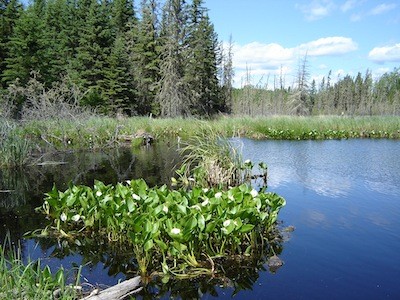
Beaver pond, Lakeland Provincial Park
The health of aquatic ecosystems is largely dependent on issues of land use. The province of Alberta has been dragging its feet on developing a land-use strategy for over 15 years. Currently, the provincial government’s goal is to release a draft Land-use Framework in early 2008.
AWA has played a leading role in advocating for such a strategy, focused in particular on public lands management. In the fall of 2004, AWA convened a public land roundtable to begin developing a vision and fundamental guiding principles for our public lands. We followed this up with A Review of Public Land Policy in Alberta, British Columbia, the United States and New Zealand, completed in August 2005. During the summer and fall of 2007, we participated in the Land-Use Framework Working Group sessions, providing input for the Land-Use Framework promised by the government.
“Water is a sacred gift, an essential element that sustains and connects all life. It is not a commodity to be bought or sold. All people share an obligation to cooperate to ensure that water in all of its forms is protected and conserved with regard to the needs of all living things today and for future generations tomorrow.”
(Keepers of the Water Declaration, September 7, 2006)
“All the water that ever has been or ever will be is here now. It sits, it runs, it rises as mist. It evaporates and falls again as rain or snow. You cannot pollute a drop of water anywhere without eventually poisoning some distant place.” (Michael Furtman, Writer)
According to demographic data released by Statistics Canada in September 2007, Alberta’s population is accelerating three times faster than the national average. It will reach an estimated nine million by 2050 if current growth rates continue.
Increased demand for water by an ever-growing human population will put huge demands on water supplies and healthy watersheds and aquatic ecosystems. Urban areas – with their higher density of vehicles and roads, construction, use of lawn chemicals, and improper waste disposal – can adversely impact watershed health. Pharmaceutical drugs, including hormones, are an increasing threat to water supplies because they are usually not filtered out by municipal sewage treatment. They negatively impact fish and possibly other animals and even humans. Some of these drugs can bioaccumulate, increasing their potency as they pass along the food chain.
“The economy is a wholly owned subsidiary of the environment, not the reverse.”
(Gaylord Anton Nelson, Earth Day Founder, 1916-2005)
What can we do?
In October 2007, Alberta Sustainable Resource Development released the Land-Use Framework Workbook Summary Report. The report compiles the views of the more than 3,000 Albertans who participated in government consultations over the summer of 2007. It acknowledges that Albertans want to see a slow-down in our rapidly growing economy. It also identifies public dissatisfaction with the “ad hoc approach” to land-use planning and concerns about inadequate environmental protection.
Agriculture is the largest single economic sector using water in Alberta. In 2005, the sector accounted for 46% of all licensed water allocations in the province. Agriculture is also a highly consumptive water user. Unlike municipalities or the power industry, for example, most water diverted by agriculture from streams is not replaced by return flows to those streams; rather it is exported as so-called virtual water in food products (see below) or it returns to the local hydrological cycle through plant evapotranspiration and some groundwater recharge. Paradoxically, the gains made over the decades by Alberta’s irrigation sector in turns of water-efficient irrigation technology decrease the quantity of return flows and increase the consumptive nature of the industry. Alberta Environment reported in 2002 that irrigation accounted for 71% of consumptive water use in Alberta.
Several studies conducted in the 1990s indicated that agricultural practices were contributing to the degradation of surface water quality in Alberta and that the potential for impacts increases as agricultural intensity increases (Alberta Agriculture, Food and Rural Development, 2000). These studies also showed the following results:
Crop production has negative impacts on water in other ways as well. Food and biofuel production and waste production are all placing greater demands on the water supply and pressures on watersheds. Most of Alberta’s wetlands have been drained and filled, primarily for agriculture.
Alberta has only 2.2 percent of Canada’s freshwater supply but supports 60 percent of the country’s irrigation. Growing irrigated crops creates a huge displacement of water. It takes about a thousand litres of water to produce a kilogram of wheat. Some argue that we are not only exporting the grains and meat we grow, but also the water required to grow them. “Virtual water” is a term that has been coined to describe the water used in the production of either manufactured goods or crops that are then exported. In Blue Covenant (2007), Maude Barlow writes, “Israeli economists first used the term virtual or embedded water in the early 1990s when they realized that it didn’t make sense from an economic point of view to export scarce Israeli water. This is what was happening, they said, every time water-intensive oranges or avocados were exported from their semi-arid country.”
What can we do?
Intensive livestock operations are becoming a primary reason for groundwater overuse and a main source of water contamination. Cattle production has increased dramatically in recent years. There are 6 million cattle in Alberta, mostly in feedlots. Add to that 1.8 million pigs, again mainly in intensive situations. Animals require enormous amounts of water, both in direct consumption and in the forage crops grown on both dryland and irrigated farms. It is estimated that it takes 5,000 to 10,000 litres of water to produce 1 kilogram of beef. On average, that’s about 50 bathtubs full of water, or about 416 toilet flushes for a small beef roast.
Together, the cattle and hogs in our province produce the sewage equivalent of 87 million humans. A 1998 study under the Canada-Alberta Environmentally Sustainable Agriculture Agreement (CAESA) found that “agricultural practices are contributing to the degradation of water quality, [and that] the risk of …degradation by agriculture is highest in those areas of the province which use greater amounts of fertilizer and herbicides, and have greater livestock densities.” The study found that one-third of samples from 857 wells exceeded the Canadian Drinking Water Quality Guidelines for maximum acceptable concentrations of at least one parameter (Alberta Farmstead Water Quality Survey, Alberta Agriculture, Food and Rural Development, 1998).
Intensive agriculture may also be related to a trend of increasing fecal coliform presence in Alberta’s rivers. A 2001 Pembina Institute report states: “A parameter of great concern is fecal coliform bacteria. Bacterial content in water is indicated by the presence of coliform bacteria. Annual average monthly data recordings of fecal coliforms present in upstream locations have shown an increasing trend on the Athabasca, North Saskatchewan, Oldman and Red Deer Rivers since the 1970s” (The Alberta GPI Accounts: Water Resource and Quality).
In addition to causing contamination of water through wastes, cattle grazing in steep forested areas and aquatic ecosystems can also contribute to stream bank breakdown and siltation.
What can we do?
| Pollutant | Source | Impact on Water | Impact on Albertans |
|---|---|---|---|
| Sediment | Agriculture fields, pastures and livestock feedlots; logged hillsides; degraded streambanks; road construction | Reduced plant growth and diversity; reduced prey for predators; clogging of gills and filters; reduced survival of eggs and young; smothering of habitats | Increased water treatment costs; transport of toxics and nutrients; reduced availability of fish, shellfish and associated species; shortened lifespan of lakes, streams and artificial reservoirs and harbours |
| Nutrients | Cow pastures, hog barns and cattle feedlots; landscaped urban areas; raw and treated sewage discharges; industrial discharges | Algal blooms resulting in depressed oxygen levels and reduced diversity and growth of large plants; release of toxins from sediments; reduced diversity in vertebrate and invertebrate communities; fish kills | Increased water treatment costs; risk of reduced oxygen-carrying capacity in infant blood; possible generation of carcinogenic nitrosamines; reduced availability of fish, shellfish and associated species; impairment of recreational uses |
| Bacteria and parasites | Raw and partially treated sewage; animal manure. | Reduced survival and reproduction in fish. | Increased water treatment costs; increased intestinal disease |
Source: Adapted from the World Resources Institute by the Calgary Herald, January 21, 1998.
A huge benefit of our wilderness areas is the opportunities they provide for recreation, emotional well-being, and spiritual renewal. Hiking, camping, canoeing, and wildlife watching are all low-impact activities we can enjoy without damaging our watersheds. But some activities, such as off-highway vehicle (OHV) use and golfing can have detrimental impacts on watersheds.
When off-highway vehicle use is not confined to hardened trails with bridges, it can contribute unnecessarily to erosion, siltation, loss of fish habitat, and destruction of wetland ecosystems. On the May long weekend of 2007, the Indian Graves and McLean Creek areas bordering Kananaskis became a party site for more than 10,000 campers and off-highway vehicle users. They did so much damage to the area that the provincial government was finally compelled to establish a Forest Land Use Zone to limit further damage to the area.
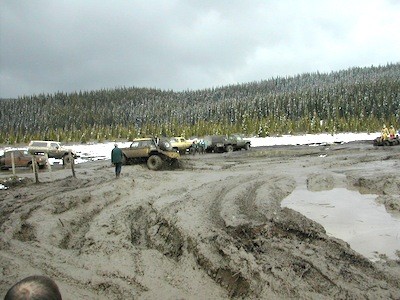
Off-highway vehicle damage in the Ghost area (AWA files)
What can we do?
Golf courses consume large volumes of water and contribute to the chemical contamination of streams through the application of fertilizers, herbicides and fungicides. Golf course development also entails clearing vegetation, cutting forests, and creating artificial landscapes. These activities often have negative environmental effects, including land erosion, which can lead to siltation of rivers and streams; loss of natural wildlife habitat, including aquatic ecosystems; and blocking of the soil’s ability to retain water.
The watershed of the Upper Bow River alone, upstream of Calgary, contains more than 50 golf courses.
What can we do?
Currently there are two ways of extracting the underground bitumen in the oil sands areas. The more accessible bitumen near the surface is mined, which requires stripping away the boreal forest and scarring the land with deep open pits and toxic tailings water bodies. An estimated 81 percent of Alberta’s oil sands are too deep to be mined in this way. For these reserves, a process referred to as SAGD, Steam Assisted Gravity Drainage, is used to heat the viscous bitumen harboured deep in the ground so the oil can be pumped to the surface.
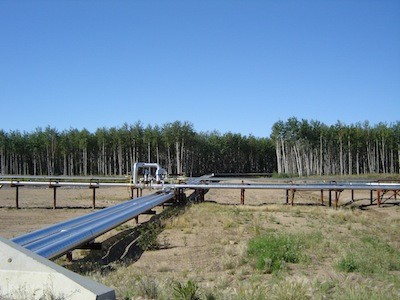
Pipelines for Petro-Canada’s MacKay River oil sands project (C. Campbell)
There is widespread recognition that this is the dirtiest oil in the world to extract, that we are literally scraping the bottom of the barrel. And the effects of oil sands development are felt far beyond Alberta’s borders. In a Globe and Mail article (October 26, 2007), Alberta oil sands projects are listed, along with other causes, as threatening Canada’s drinking water.
Tailings ponds such as this one next to the Athabasca River now cover approximately 50 km2 in the oil sands region north of Fort McMurray.
The changes that will be necessary to slow or halt further oil sands exploitation are made more challenging by the North American Free Trade Agreement (NAFTA). According to Maude Barlow, by currently using water from the Athabasca River to exploit the oil sands, American companies under NAFTA have established their “right” to that water.
“[I]f the Alberta government were to impose new regulations in the tar sands production in order to protect its water resources, the American energy companies would have to be grandfathered or paid substantial financial compensation” (Maude Barlow, Blue Covenant, 2007).
Oil Sands Reclamation
Reclamation of oil sands mines is not the panacea that it is often proclaimed to be. By the end of 2003, of the 33,000 ha of Alberta land disturbed for oil sands operations only 5,600 ha were under active reclamation. To date, after three decades of oil sands development, no reclamation certificates have been issued for land in the mineable oil sands area. Moreover, there is no known process to restore peat wetlands once destroyed. The habitat substitution of reclaimed grasslands in place of wetlands has unknown effects on the overall functioning of aquatic ecosystems, water quantity, and water quality in the boreal forest, and will almost certainly reduce biodiversity.
What can we do?

With demand for natural gas continuing to grow and conventional supplies on the decline, the oil and gas industry has turned its attention to coalbed methane (CBM) extraction.
CBM is found in the coal seams that underlie much of central and southern Alberta. Commercial production of CBM began in 2002. Coalbed methane wells tend to be shallow and lower-producing than conventional gas wells. Because of this, CBM typically involves a higher density of wells which in turn creates a greater level of disturbance on the land. The building of roads, pipelines, and well pads fragments and results in loss of wildlife habitat. These activities also negatively impact native vegetation.
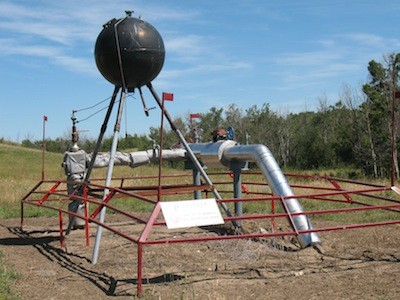
A coalbed methane well in Rumsey Natural Area
Pembina Institute researchers Mary Griffiths and Chris Severson-Baker note that “the effect on the landscape will be greatest in wilderness areas and areas that do not already have an existing network of roads and pipelines. Yet, even in areas where oil and gas developments have already imprinted on the land, the additional effects of CBM operations may be dramatic due to the large number of well sites that may be needed” (Unconventional Gas: The Environmentaopmeta, June 2003)
It would indeed be prudent for the government to proceed with extreme caution in this relatively new area of resource extraction. CBM deposits are found throughout the populated Edmonton–Calgary corridor. Potential contamination of groundwater and/or surface water would have far-reaching impacts.
Alberta’s recent Royalty Review Panel recommended a lowering of royalties on low-producing wells. The Parkland Institute has criticized this recommendation, stating it will serve to stimulate increased coalbed methane development (Selling Albertans Short: Alberta’s Royalty Review Panel Fails the Public Interest, October 2007)
What can we do?
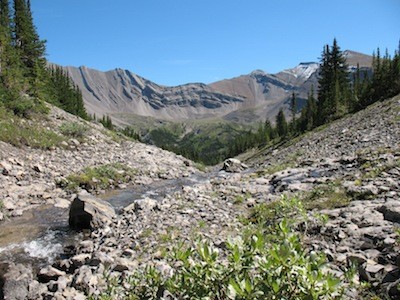
Willmore mountains (J. Hildebrand)
“To protect your rivers, protect your mountains.” (Emperor Yu of China, 1600 B.C.E)
Forests provide a broad range of valuable ecological services. They store water and purify it, maintain biodiversity, reduce air pollution and provide places for healthy recreation.
If a forest becomes unable to intercept, hold, filter, and slowly release pure water, its watershed is in trouble. In 2001 the UN warned that forests reduced by 40 percent can no longer provide full ecosystem services such as wildlife habitat, flood control and water purification. Some of Alberta’s forests have been reduced by 50 percent due mainly to logging and road building.
What can we do?
“The reality is that fresh water is more valuable than crude oil.” (Peter Lougheed, Former Alberta Premier, 2005)
Traditionally, water has been seen as being so abundant as to have no value. With the increasing realization that water is indeed limited in supply and more cannot be manufactured, its value is rising. This is leading to increased pressure to privatize water and turn it into a tradable commodity, like coffee or oil. Former Alberta Premier Peter Lougheed has cautioned against the commodification of water, saying, “With climate change and growing needs, Canadians will need all the fresh water we can conserve, particularly in the Western provinces” (Globe and Mail, Nov. 11, 2005).
The North American Free Trade Agreement (NAFTA) greatly hampers Canada’s ability to protect and conserve its water resources. NAFTA uses the General Agreement on Tariffs and Trade (GATT) definition of a tradable good, which includes water. Successive governments have denied that bulk water trade is included in NAFTA , but in 2001, when a business group in Newfoundland applied to export water from Gisborne Lake to the United States, then-Environment Minister David Anderson stated, “If Canada starts treating water as a commodity, or as an item of trade, it will ultimately be treated as an item of trade under NAFTA.” Under NAFTA rules then, if any province decides to export water, other provinces might be forced to follow suit.
Currently all provinces except New Brunswick have legislation in place banning the export of water and/or banning interbasin transfers. But in the absence of a strong federal policy, any province can change its legislation at any time and potentially affect the ability of all provinces to protect and conserve their water.
If proposals such as the Eastern Irrigation District’s recent request for an amendment to its water licence to allow it to lease or sell a portion of its water allocation were approved, this would be a step toward the commodification of water. AWA believes that water is a resource whose management and distribution should be kept in the public domain.
What can we do?
Global warming has emerged as the major issue of our day, threatening life on every corner of our planet. Industry is the major contributor to increasing greenhouse gas emissions. Alberta contributes about 30 percent of Canada’s total greenhouse gas emissions.
Most of Alberta’s emissions come from coal-fired electrical generating stations, oilsands exploitation, increasing intensive feedlot operations, and continuing conversion of forest and natural grasslands to cropland. Of these, oil sands exploitation will be by far the single fastest growing contributor in the near future. Leaks from natural gas pipelines continue to be a major source of greenhouse gases as well. In terms of personal consumption, emissions from transportation are up, in part due to increasing purchases of light trucks and SUVs – in 2005 emissions from this category were up a whopping 109 percent in Canada (Calgary Herald, October 1, 2007).
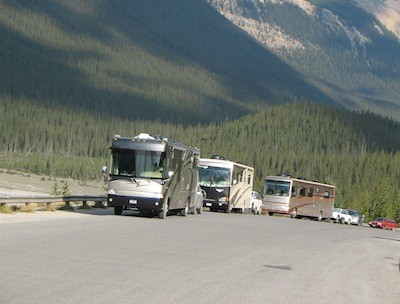
Banff – Jasper Parkway (J. Hildebrand)
The Eastern Slopes of the Rocky Mountains is the birthplace of four major river systems that carry water through all three prairie provinces and the Northwest Territories. Our current experience of global warming has seen colder weather arriving later in the fall, milder winters with more rain than snow, and earlier springs. Environment Canada’s Climate Change Impacts report notes that “glacier cover is now approaching the lowest experienced in the past 10,000 years.” Glaciers and the winter snowpack are nature’s reservoirs, storing water and releasing it through the hot summer months. With less total snowpack, and with glaciers fast disappearing (some predict the Bow Glacier will disappear within the next 30 years), water security for all life is threatened.
Rising temperatures also mean an increase in evapotranspiration, the process through which moisture is lost through both evaporation of surface waters and the breathing out of moisture by plants. We are already experiencing the results of this in more parched soils, the drying up of wetlands, and reduced flows in rivers and streams, all with significant impacts on humans, plants, and wildlife.
In the prairie provinces, global warming will likely be exacerbated by lengthy periods of drought that have been common in the region for centuries. The last 100 years have been somewhat of an anomaly in that scientists now believe they have been the wettest for at least a couple of millennia. According to water expert David Schindler, “Most earlier centuries had one or more prolonged droughts, some [lasting] 10-40 years.”
Many of the world’s most renowned scientists now fear that global warming may soon proceed with “speed and violence,” to use the words journalist Fred Pierce chose for the title for his 2007 book. At a meeting of the American Geophysical Union in December 2005, James Hansen of the NASA Goddard Institute for Space Studies warned, “We are on the precipice of climate system tipping points beyond which there is no redemption.” The recently released Global Environment Outlook (October 2007), produced by authors from around the world for the UN Environment Program, reiterates the same concern: “Biophysical and social systems can reach tipping points, beyond which there are abrupt, accelerating, or potentially irreversible changes.”
One such tipping point was identified in Environment Canada’s report, Threats to Water Availability, cited by Chris Wood in his article “Melting Point” (Walrus, Oct. 2005):
“A climate-change time bomb will go off in the Arctic if peat, frozen for centuries beneath northern muskeg, begins to thaw and decompose – releasing billions of tonnes of greenhouse gases. ‘Canada’s peatlands are overwhelmingly important,’ notes Threats. They ‘contain twenty-five times the amount of fossil-fuel carbon released each year by the entire world.’ If released, the peat would initiate a feedback loop that could kick global warming into the catastrophic range.”
Our situation is not hopeless, however. The implementation of the Montreal Protocol of 1984 that suddenly and severely limited the production of ozone layer-destroying chlorofluorohydrocarbons (CFCs) shows that the world can take collective environmental action with immediate positive results.
What can we do?
Not only is our population burgeoning in Alberta, but our levels of consumption are also skyrocketing. The “ecological footprint analysis” is a tool for determining if our lifestyles are sustainable. Ecological footprint is a measure of the load that human activities impose on nature. It calculates how much land is necessary to sustain current levels of resource consumption and waste discharge.
In Alberta, rather than changing our lifestyles to curb consumption and make progress toward sustainability, we increased our ecological footprint by 76 percent from 1961 to 2003. The ecological carrying capacity of the earth allows for just 1.8 ha/person. Alberta’s footprint now sits at 9 ha/person, making it the fourth largest in the world – 21 percent larger than the average Canadian footprint (Pembina Institute, August 2005).
The implications for water are great. Both energy and food, by far the two largest components of our ecological footprint, are particularly water intensive in Alberta. Heavily irrigated crops, intensive livestock operations, and water-intensive bitumen extraction in the oilsands all contribute to our oversized footprint. In addition to this, the emerging biofuel economy will undoubtedly also contribute to the growth of our footprint.
The bottom line is that our consumption, and the waste that accompanies it, places a huge burden on the earth’s water systems and is not sustainable.
What can we do?
Production and processing of biofuel is being promoted by both federal and provincial governments as a positive development that will boost rural economies and reduce greenhouse gases. But some biofuel production – particularly ethanol, which is made from crops like wheat, corn, and canola – involves high water use – is not compatible with Alberta’s semi-arid and drought-prone prairie landscape. In addition to the water necessary to grow crops, processing plants use from three to ten litres of water to produce one litre of ethanol. Ranchers have also raised concerns that biofuel production will raise the cost of feed as the energy sector competes with ranchers for crops.
Investing in biofuels will contribute to increased water stress in the prairies.
According to John Pomeroy and Michael Solohub of the Centre for Hydrology at the University of Saskatchewan, prairie agriculture has become more effective at using rainfall and snowmelt. Unfortunately, this efficiency has reduced the amount of surface water available to feed streams, fill small lakes, and recharge groundwater. Studying the prospects for biofuel, Pomeroy and Solohub concluded that using water for biofuel production and processing will “tend to use most or all available soil water in drier parts of Canada and reduce streamflow everywhere.” In turn, diminished streamflow will “reduce water availability for ecosystem services and human use and may degrade water quality in some cases” (November 2006, Biocap Canada Conference, Ottawa).
In their article published in the journal Science (August 2007), Renton Righelato of the World Land Trust and Dominick Spracklen of the University of Leeds conclude that “[i]f the prime object of policy on biofuels is mitigation of carbon dioxide-driven global warming, policy-makers may be better advised in the short term (30 years or so) to focus on increasing the efficiency of fossil fuel use, to conserve the existing forests and savannahs, and to restore natural forest and grassland habitats on cropland that is not needed for food.”
What can we do?
Scientists advise extreme caution in considering transfers of any quantity of fresh water from a river, lake, or aquifer. According to author Kevin Ma (The State of the Sturgeon River and the Alberta Water Crisis, 2006), water transfers between basins “almost guarantee the transfer of fish, plants and parasites between watersheds, creating fox-in-the-henhouse situations where newly introduced species run rampant due to lack of natural predators.” (R.V. Rasmussen – raysweb.net)
Alberta’s Water Act divides the province into seven large water basins. A special act of the legislature must be passed to allow for transfer of water between these basins. But each basin has many sub-basins, and transfers between sub-basins, known as intrabasin transfers, are permitted and occur frequently. For example, the Bow, Oldman, and Red Deer River watersheds are considered sub-basins of the South Saskatchewan River basin.
For decades, water has been withdrawn from the Bow River by the Western Irrigation District and Eastern Irrigation District, while return flows from these districts enter the Red Deer River.
Each sub-basin is distinct, and many have questioned the wisdom of allowing further transfers between them. This issue was recently brought to the forefront by a development near Balzac comprising a racetrack, casino, and mall. In April 2007 project construction was suspended since the developer had not secured a license for a water supply. With a moratorium on additional water allocations from the Bow and South Saskatchewan rivers, the developer looked to divert water from the Red Deer River for the project’s water supply. Since the proposed diversion was considered an intrabasin transfer, no special legislative action was needed to proceed with this transfer.
Public concern about this potential intrabasin transfer prompted Alberta Environment to create an Alberta Water Council Project Team to examine the implications of such transfers and to make suggestions for policy changes, if necessary – its report was still pending as of November 2007. In the end, the Balzac development secured water from the Bow River by buying a portion of a water license allocation from the Western Irrigation District.
Diversions of a river’s flow always carry ecological consequences and need to be considered carefully.
What can we do?
“What will happen in the tar sands when we must admit that the Athabasca River has given all she can to the steaming of bitumen? How many more casinos and race tracks will we contemplate in the Balzacs of Alberta when all the river basins are at maximum demand capacity in an era of declining flows?”
(Mike Robinson, President, Glenbow Museum, September 21, 2007)
Overallocation of a water resource results in insufficient instream flow to support healthy aquatic ecosystems. Water scientist David Schindler warns that waterways in southern Alberta are close to the point of no return. He says they still could be saved, but firm solutions are needed (Edson Leader, October 22, 2007).
In the northern part of the province the majority of water licences issued on the Athabasca River are for oil sands exploitation. “The oil sands are very close to oversubscribing the flow of the Athabasca,” Schindler says (William Marsden, Stupid to the Last Drop, 2007).
The roots of the current crisis of overallocation of the water supply in southern Alberta reach back to 1894 with the creation of Canada’s Northwest Irrigation Act. The intent of this act was to attract settlers to the prairies. Jeremy Schmidt, a PhD student at the University of Western Ontario, writes, “The government tied water licences directly to land claims and put few, if any, expiry terms on these agreements” (Alternatives 33:4, 2007). Water was allocated in a “first-in-time, first-in-right” basis. This created a hierarchy of licence holders, with senior licencees having the right to withdraw their full entitlement before junior licence holders receive their share of water.
With the 1930 Natural Resources Transfer Act, the provinces received authority to manage their own natural resources. In 1931, Alberta passed its own Water Resources Act and continued with the “first-in-time, first-in-right” system.
Water allocation proceeded with little understanding of the instream flows needed to maintain healthy aquatic ecosystems. When drought conditions led to water licences exceeding the available supply for the first time ever in 2001, the government began to look more seriously at ways to conserve water and increase water efficiency. In 2002 Alberta moved to a water market system that allows water licence holders to either transfer permanently or assign temporarily, for a price, the water rights formerly tied to their land. This move was intended to increase flexibility by, for example, allowing farmers who do not need their full allocations to transfer or assign a part of their water allocation to farmers who are experiencing shortages. A provision to hold back a maximum of 10 percent of the transfer amount was also incorporated into the water market. This measure is an attempt to address the issue of overallocation.
Questioning the ability of this provision to improve the viability of southern Alberta’s rivers, Jeremy Schmidt writes, “[W]ater is currently so overallocated that even if every licence changed hands twice – allowing for conservation holdbacks of up to 20 percent of allocated water – there would be only a moderate increase in flows left for the environment since, under the provisions of the system, recovered water would first go to junior licence-holders who do not receive their full allocations when there isn’t enough water to go around” (Alternatives 33:4, 2007).
In January 2007 the Government of Alberta established Water Conservation Objectives (WCOs) to be at least 45 percent of the natural rate of flow of the rivers within the South Saskatchewan River basin. However, with the exception of the Red Deer River, more than this amount has already been allocated in water licenses in this basin. As a result, in Alberta Environment’s words, WCOs are only “flow targets” that “provide direction on opportunities to increase flows in the highly allocated rivers in the Bow, Oldman and South Saskatchewan River Sub-basins.” (Source: http://www3.gov.ab.ca/env/water/regions/ssrb/WCO.html, retrieved November 19, 2007)
On August 21, 2007 the Eastern Irrigation District (EID) applied for an amendment to its water licences to broaden the purposes of those licenses from “irrigation and agriculture (stockwatering) purposes” to include many additional purposes, namely “municipal, agricultural, commercial, industrial, management of fish, management of wildlife habitat enhancement, and recreation” for their entire licensed water allocation.
The EID, the largest water licence holder in southern Alberta, received most of its water allocation in a1903 license, making it a very senior license holder. According to the Bow Riverkeeper organization, “On average, the EID only uses 76 percent of their allocated water. Some years, they use less than half of their allocation. There needs to be a debate over whether unused water should go back to the public domain. This proposal is a step in the opposite direction, encouraging the EID to maximize use of its existing license” (Bow Riverkeeper news release, Sept 5, 2007).
On October 23, 2007 the Government of Alberta decided to defer the EID request until it reviewed its policy on water license amendments in the South Saskatchewan River basin.
AWA believes that if Alberta Environment grants this request, or others like it, overall water management and allocation in the province will move out of public control into a private water market where environmental impacts are likely to be given low priority. Water management, including re-allocation of existing licenses, should be overseen by government, in the interest of the aquatic environment and of the general public, with opportunity for public input.
What can we do?
Roads, pipelines, and seismic lines can all be classified as “linear disturbances.” They crisscross our landscape with increasing density and have ecological consequences on wilderness, including forests, rivers and streams, and wildlife.
When such disturbances cross streams, they can increase bank erosion and stream sedimentation, alter drainage patterns, and destroy fish habitat. In addition to the damage that is initially caused, ongoing use of these pathways by off-highway vehicles and snowmobiles can continue and even increase the contamination of streams.
Forest ecologist Brad Stelfox has developed an award-winning landuse simulation tool. He has used it to track the alarming growth of human impact, including linear disturbances, on Alberta’s landscape and to predict future scenarios. Roads and seismic lines increase public access across the land, and managing access is a key issue in safeguarding our watersheds.
What can we do?
AWA continues to chair the Alberta Environmental Network’s Water Caucus, organizing its monthly calls and distributing the agenda and summary minutes for these meetings. Water Caucus members continued to exchange information on various water issues across the province including coal mining and oil sands impacts on water, AEP’s regulatory transformation, and the irrigation expansion project in the South Saskatchewan River Basin.
In August, AWA reached out to Alberta Transportation and the Special Areas Board to inquire about the current status of the Special Areas Water Supply Project. The Special Areas Board responded by saying that after reviewing the Engineering Confirmation study and the Environment Impact Assessment, the Special Areas Board moved not to advance further funding to the Special Areas Water Supply Project at this time.
In June, AWA submitted a letter to AEP detailing our comments on the Bow River Reservoir Options Phase 2 Feasibility Study. AEP is investigating three reservoir options for flood mitigation along the Bow River upstream from Calgary. Upon reviewing the available information, AWA does not support the creation of new on–stream dam infrastructure as a strategy for flood mitigation for Calgary and the surrounding communities. We feel that better alternative flood mitigation strategies exist – through improving upstream land uses and limiting future commercial, industrial, agricultural, and residential developments within the ecologically vital flood plain of the Bow River.
AWA submitted a comment letter addressing the draft Athabasca River Integrated Watershed Management Plan (IWMP), produced by the Athabasca Watershed Council (AWC) which was open for public feedback until June 30, 2021. AWA considers the IWMP to be an important strategic document that provides direction and a roadmap for future AWC–WPAC and partner activities. The recommendations we included would further strengthen this document through including more meaningful actions to protect the watershed for current and future generations.
In March, AWA, along with several other ENGOs including Southern Alberta Group for the Environment (SAGE), Trout Unlimited Canada, and Bow Valley Naturalists submitted a letter to government ministers at both the provincial and federal levels outlining our shared concerns regarding the recently approved project to expand irrigation infrastructure in the SSRB. This project proposes to upgrade open canals into pipelines, to build new and expanded storage reservoirs, and to increase irrigation acres within eight irrigation districts in the SSRB. We are asking that this monumental project be subject to the necessary environmental assessments, regulatory review, and opportunities for public and indigenous consultation and input.
In July, AWA submits our concerns to the Government of Alberta about a proposed gravel mining operation that we believe could harm aquatic ecosystems in a sensitive flood plain area between the Red Deer and Medicine Rivers.
In June, AWA writes a letter to the provincial government outlining the significant financial and environmental drawbacks of the Special Areas Water Pipeline proposal. An AWA representative was elected to the Board of the Red Deer River Watershed Alliance.
In May, AWA comments on draft Canadian water quality guidelines for neonicotinoid insecticides; we were
concerned the draft thresholds were too low for exposure events, and did not consider environmental conditions and interactions with fertilizers and other chemicals that can intensify the pesticides’ impacts.
In March, for the Peace watershed, AWA comments on the Wapiti River water management plan. We generally supported its overall objectives, and how its proposed Water Conservation Objectives were chosen to maintain a certain level of ecological integrity while addressing social and economic demands.
In January, AWA commented on draft Canadian groundwater quality guidelines, seeking stronger linkages between cumulative land–use issues and groundwater quality.
In November, AWA became the ENGO representative for the new wetland technical advisory committee (TAC) within the federal–provincial Oil Sands Monitoring program.
In October, AWA submits comments to the Government of Alberta on Bow River flood mitigation concepts. AWA believes that the primary strategy for flood mitigation for Calgary and surrounding communities should not be on–stream dam infrastructure, but rather upstream land use improvements, and strictly limiting the future establishment of commercial, industrial and residential developments within the floodplain of the Bow River.
In September, a guest–authored article outlining how wetland policy is applied in Alberta’s settled areas, describing progress and gaps remaining in wetland policy implementation there, is presented in the Wild Lands Advocate.
In September, Alberta’s Wetland Policy is finally released. The policy finally abandons the concept of no-net loss of wetlands, and exempts all approved and near-term foreseeable oilsands projects from wetland offsets or restoration. Environmental groups believe the policy is not sufficient to protect wetlands of significant biodiversity and ecosystem function. The policy contains no overarching goal to maintain wetland area (contrary to the non-consensus recommendations of the Alberta Water Council) let alone to maintain or restore wetland function. Avoidance of damage to existing wetlands is given only lip service, in favour of minimizing disturbance impact and mitigation. If a company decides that avoidance is “not practicable” they must “adequately demonstrate that alternative projects, project designs, and /or project sites have been thoroughly considered and ruled out for justifiable reasons.” Any compensation payments for wetland loss will not necessarily be spent on wetland replacement: instead they may be spent on education or outreach.
In August, the Alberta government releases a report that it received in December 2012 recommending safety improvements in Alberta’s pipeline system. Key findings include a need for better management of water body crossings, stronger inspection and testing requirements in high risk areas, and stronger audit and enforcement capacity by the energy regulator.
In June, floods cause extensive damage across southern Alberta. Trails throughout areas such as Kananaskis Country, the Ghost and the Bighorn suffer enormous damage.
In March, a burst waste water line at a Suncor Energy tar sands strip mining operation causes 350,000 litres of contaminated water to overflow in to the Athabasca River. This is the second toxic water spill to occur from Pond C in the past two years.
Alberta’s Westslope Cutthroat Trout is finally designated as a threatened species, seven years after COSEWIC submitted the recommendation to the federal government. The species was once widespread throughout southern Alberta but is now found only the the Bow and Oldman drainages.
In December, ignoring calls from its own Fish and Wildlife Scientists, Alberta Environment and Sustainable Resource Development allows logging in Hidden Creek, the most important spawning grounds for threatened bull trout in the entire Oldman River system in southern Alberta, and also home to threatened westslope cutthroat trout.
In June, a pipeline leak north of Sundre spills between 1,000 and 3,000 barrels (160,000-475,000 litres) of light sour crude oil into the Red Deer River, a major drinking water source for southern Alberta, via Jackson Creek, which contains threatened bull trout. This news comes only weeks after a pipeline leak in northern Alberta spills approximately 5,000 barrels (800,000 litres) of oil into surrounding peat wetlands.
In April, a new research paper by a University of Alberta ecologist, Dr. Lee Foote, concludes that the government should negotiate mineable oil sands development limits. The paper cites doubtful reclamation success for the extensive peat wetlands central to that landscape. Dr. Foote’s paper states that:
In March, University of Alberta scientists Rooney, Bayley and Schindler release a study emphasizing that peatlands cannot be reclaimed once destroyed by tar sands mines. As they cover 65% of the pre-mining landscape, this loss will have far-reaching impacts on regional ecology and biodiversity that have not been assessed. This loss also represents a large unaccounted-for source of carbon emissions.
In July, Special Areas water Supply project rears its ugly head once again. The Special Areas Water Supply Project would remove an undetermined volume of water from the Red Deer River to be used principally for irrigation agriculture, as well as some municipal improvement and undefined “environmental” uses. The proposal would see Albertans foot the enormous bill for a low value, environmentally-damaging engineering project.
The Project has been on the government books, in one form or another, for twenty years. The previous version of the proposals, which AWA fought strongly against in 2005, would have seen a $200 million bill paid by the Alberta taxpayer (or $60 paid by every single Albertan!). For its minimal economic benefit (a government economic study found that the project would return only 70 cents per dollar spent), the project had potential to do significant damage to the Red Deer river ecosystem and to areas of native grasslands which stood to be ploughed up and used for irrigation agriculture.
Although the Alberta government announces that it will be carrying out a three-year environmental assessment of the project, no details are released concerning how the project compares to previous versions: what the cost will be, or how much water will be removed.
In March, toxic water is released from water from Suncor Energy’s Pond C into the Athabasca River.
In July, the Alberta Utilities Commission (AUC) launches an inquiry to examine opportunities to “streamline” regulatory processes for hydroelectric power generation projects. AWA commissions and submits to the AUC two original reports to inform its own participation in this inquiry. One study details the impacts of hydroelectric projects – from large dam reservoirs to micro-hydro run-of-river projects – on riverine ecosystems, the other study examines impacts to river corridors and uplands from hydroelectric projects that could further jeopardize Alberta’s meeting its biodiversity commitments. In the coming year AWA will participate in inquiry workshops and submit final comments on the importance of an overarching protected areas strategy plus rigorous environmental assessment and cumulative effects management of hydroelectric developments.
In spring, AWA helps publicize a leaked provincial wetland policy draft that indeed removes the “no net loss” policy goal and drastically downgrades boreal peatlands because of unproven assertions that abundant wetlands have less value. AWA continues to advocate for a provincial wetland policy that values the critical importance of both boreal and prairie wetlands on the landscape and works to protect them from further loss at a provincial scale. Progress on this policy had stalled since autumn 2008, after the three year process of the Water Council Wetland Policy Project Team yielded a compromise policy supported by 23 of 25 sectors, with non-consensus letters from the tar sands mining and petroleum sectors.
In spring 2010, AWA is instrumental in bringing to light a public web site posting by the Alberta Chamber of Resources, a tar sands industry association, that the provincial government had in early 2009 agreed to their key demands to undermine the “no net loss” policy.
In March, AWA presents our research on groundwater risks from in situ tar sands development to First Nations and other community members in Anzac, the town of Athabasca, Lac La Biche and Cold Lake. AWA joins with other groups in opposing the precedent-setting application by Nexen Inc. to sharply revise its Long Lake in situ water plan towards reliance on the Clearwater River water for its freshwater requirements instead of local groundwater sources as it had pledged to do. AWA also participated on the multi-stakeholder federal-provincial committee recommending long-term withdrawal rules and monitoring of Athabasca River water withdrawals by tar sands mines, which completed its work in early 2010. With other ENGO partners, AWA strongly advocates for an absolute cutoff of withdrawals during low winter flows. To aid in transparency and decision making, AWA develops a model to present compliance costs of various rules in the context of other capital costs incurred by tar sands companies. The overall work of this committee is presented to community members in the town of Athabasca in March 2010. AWA also presents at a climate change adaptation conference in Austin, Texas on the innovative modeling of climate change-affected river flows by this Athabasca committee.
In May, following up on the November 2008 science workshop, an implementers workshop discusses best practice management of parks, forests, rangeland and municipalities in the headwaters. One affirmation of this work is the selection by the Bow River Basin Council of land use focused on wetland, riparian and headwaters regions for its Phase 2 watershed management planning. AWA advocates for source water protection as the Eastern Slopes priority land use within the South Saskatchewan region’s land use planning.
In November, collaborating with several government and non-government organizations, AWA takes a lead role organizing two workshops to build awareness and support for excellent headwaters management. Decision makers and policy influencers from the North and South Saskatchewan watersheds attend the November 2008 science workshop, featuring top researchers discussing the effects of headwaters snow pack, multiple land uses and climate change on downstream water quality and quantity.
In November, AWA’s water economist and conservation specialist Carolyn Campbell attends the first Alberta Water Council meeting that includes the new members (including AWA), who were appointed in December 2006. The new members did not gain full membership until the transition to non-profit status was complete.
A coalition of citizen-based organizations, including AWA, submits a report to the Alberta Water Council called Recommendations for Renewal of Water for Life: Alberta’s Strategy for Sustainability. The issues addressed include the need for source water protection, insufficient progress on protecting healthy aquatic ecosystems, integration of land use and water use in watershed planning, improving conservation by moving from supply-side to demand-side management, and watershed governance.
On October 26, the Alberta government defers its review of the Eastern Irrigation District’s application to amend its water licenses while examining the current policy on water license amendments related to the South Saskatchewan River Basin.
“With most of the South Saskatchewan River Basin closed to new license applications, concerns have been raised about the Alberta government maintaining its authority to oversee water resources. We need to ensure water is allocated in a fair manner with opportunity for all users to have access to water resources” (Environment Minister Rob Renner, Government of Alberta News Release).
On October 3, the Alberta Water Research Institute issues its first call for proposals to “tackle some of Alberta’s most pressing water-related environmental issues, including habitat decline, biodiversity loss, water flow and water quality” (AWRI and Alberta Ingenuity Fund News Release).
On September 28, Alberta Environment approves a water transfer from the Western Irrigation District (WID) to the MD of Rockyview for a controversial development near Balzac that includes a racetrack, mall, casino, and veterinary college. Concerns have been raised that this development does not constitute a wise use of water in a water-scarce region. This transfer will be the largest and most expensive ($15 million) water allocation transfer in the province since the inception of the water allocation trading system in 2002.
The government applies the maximum 10 percent holdback (under the Water Act) to this transfer: 10 percent of the water transfer is held back to contribute to streamflow in the Bow River. This is a small success for the environment.
On September 27, the Horseshoe Lands Area Structure Plan unanimously passes its third reading in the MD of Bighorn Council. This plan includes a new townsite that will accommodate up to 5,600 people in 2,900 residences, as well as commercial and industrial facilities, on the banks of the Bow River near Seebe.
The environmental community opposes this plan because it has no guaranteed source of water for its full implementation. In addition, no environmental impact assessment has been undertaken to assess the cumulative impacts of the proposed development, including impacts on the aquatic environment and the water resources in the region.
From September to October, AWA participates in public consultations initiated by the Wetland Policy Project Team of the Alberta Water Council about a new Wetland Policy and Implementation Plan. The information gathered will guide the drafting of the new policy, which the Team plans to deliver to the government by early 2008.
On August 21, the Eastern Irrigation District (EID) applies for an amendment to its water license to allow it to lease or sell a portion of its water allocation. The EID is the largest water license holder in southern Alberta. It received its allocation in 1903 and uses only an average of 76 percent of its allocated water. “There needs to be a debate over whether unused water should go back to the public domain. This proposal is a step in the opposite direction, encouraging the EID to maximize use of its existing license” (Bow Riverkeeper News Release, September 5, 2007).
Of deepest concern is that granting this request will take water out of public control. It will allow the EID to profit from water that it receives for free in a private water market. “The purposes for the water and its allocation should be subject to the constraints of Alberta’s Water Act and dealt with through basin plans and the market mechanisms for license transfers that are available in the Water Act…. This would be another poor decision if it were to be approved, allowing water allocation decisions without public input or government direction” (Wild Lands Advocate, October 2007).
On August 2, 328 farmers of the Western Irrigation District vote 57 percent in favour of transferring some of their Bow River water rights to the mega-mall, casino, horse track, and veterinary college development near Balzac. This $1 billion development just north of Calgary is the largest project in Alberta outside of the oil sands.
In July, AWA releases a position paper on forestry, The Forests of Alberta’s Southern Eastern Slopes: Forests or Forestry?, calling for a full independent comprehensive review of forestry in southern Alberta: “Alberta Wilderness Association (AWA) is committed to maintaining healthy and intact forest ecosystems that will sustain biological diversity and viable wildlife populations, provide clean drinking water and promote long-term economic opportunities…. Water quality and quantity are recognized as key products of all forests and a primary product of the Eastern Slopes watersheds.”
In June, the Southern Alberta Land Trust Society releases The Changing Landscape of the Southern Alberta Foothills. This is the final product of the Southern Foothills Study (SFS), led by Dr. Brad Stelfox.
“SFS is a broad alliance of municipalities, landowners, industry, and environmentalists, including AWA, formed in 2005 to study current and future land-use trends and to provide a base upon which local landowners and government can plan for the future. The study area comprises 1.22 million hectares of fescue grassland, foothills, forest, and mountains” (Wild Lands Advocate, February 2007).
The study used the ALCES (Alberta Landscape Cumulative Effects Simulator) model to conclude that 50 years from now, “business as usual” will lead to a slow but steady environmental degradation of the south Eastern Slopes of the Rocky Mountains, including the following: doubling of the human population, 56 percent increase in number of cattle, increase of cutblock edge from 2,500 to 6,500 km, annual increase of 300 to 500 km of seismic lines, and 25 times increase in number of wells.
The results of the study were presented to 600 members of the public through a series of seven public meetings. Feedback from both the written survey (distributed at meetings) and a random sample telephone survey of an additional 800 people indicates that water quality and quantity is an area of very high concern. The written survey results showed that “reduced water quality” was the issue of greatest concern, with 84.8 percent of respondents saying they were “very concerned”; only 24.3 percent were “very concerned” about the loss of recreational areas. The written and telephone surveys also indicate that watershed protection was the “primary concern” of respondents. Over 70 percent of all respondents were “very concerned” about the diminished water quality and quantity predicted by the “business as usual” scenario.”
As part of a letter-writing campaign to establish Andy Russell-I’tai sah kòp Park in the Castle Wilderness, Sierra Club notes, “Although comparatively small in land area, the proposed park is the single largest source of flowing water for the Prairie Provinces and the importance of its protection was noted in the recent Rosenberg International Forum on Water Policy.”
In May, since the launch of the Water for Life strategy in 2003, 14 percent of Alberta’s land base (23 percent of the province’s public land) has been leased for petroleum and natural gas production. More than 18 percent of those leases were sold for oil sand exploration, which is – along with agriculture – one of the thirstiest of our industries.
In April, a coalition of 12 conservation and landowner groups, including AWA, sign on to a letter to Premier Ed Stelmach requesting a temporary moratorium on development in the Eastern Slopes watersheds. The coalition requests an initial response within two weeks and also requests meetings with the ministers of Environment, Sustainable Resource Development, Energy, and Municipal Affairs.
On June 8, 2007, the Premier turns down the request. John Cross, owner of the A7 Ranche at Nanton and a signatory on the coalition’s letter, describes the Premier’s response as “business as usual” until the new Land Use Framework guidelines are completed, meaning a continued increase in environmental degradation. A draft of the Land Use Framework is expected by early 2008.
Dr. David Schindler, a Killam Memorial Professor of Ecology at the University of Alberta and world-renowned water expert, is named chair of the Water Institute’s international research advisory council.
The Pembina Institute report Protecting Water, Producing Gas is released. This report highlights a number of groundwater issues that need addressing in the province:
In March, the Rosenberg International Forum on Water Policy releases its report Lessons for Canada and Alberta. The report highlights the importance of undertaking headwater protection. The authors conclude, “Upland watershed protection will become more and more important as population growth, diminishment of water supply and climate change conspire to change the hydrology of the Canadian West.” In particular, the headwaters of the Oldman River Basin “may be a good candidate for special watershed protection.” The report highlights the proposed Andy Russell–I’tai sah kòp Park in particular, stating that its protection “will pay for itself over and over again in the value of ecological services it provides alone” (Rosenberg International Forum on Water Policy, Program Synopsis and Lessons for Canada and Alberta, Forum V Report, pp. 90-91).
The Beaver River Watershed Alliance becomes the official Watershed Planning and Advisory Council (WPAC) for the Cold Lake/Beaver River area.
Environment Minister Rob Renner initiates a renewal of the Water for Life strategy. The review is undertaken by the Alberta Water Council and includes a public consultation process.
In February, Report of the Rosenberg International Forum on Water Policy to the Ministry of Environment, Province of Alberta is published. The Rosenberg Report, as it becomes known, is an analysis of the Water for Life strategy and was commissioned by the Alberta government in September 2006. The report emphasizes the importance of acknowledging the link between surface and groundwater, stressing that “the plan does not account sufficiently for groundwater or the relationships between water-air-land.” Among its many recommendations are the following:
Water Management Framework for the Lower Athabasca is released. The claim is that it “is designed to protect the ecological integrity of the lower Athabasca River during oil sands development.” In a joint news release, Athabasca Chipewyan First Nation, Fort Chipewyan Elders, Mikisew Cree First Nation, and Pembina Institute take issue with that declaration, stating that the government is “misleading Albertans and Canadians because it does not require industry to turn off its pumps when the river hits the red zone.” The framework defines three status levels – green, amber, and red – depending on in-stream flows. The red status is defined as “a zone where withdrawal impacts are potentially significant and long-term, depending on duration and frequency of withdrawals” – in other words, where withdrawals threaten the river’s ecological integrity. Although the Framework caps the amount that can be withdrawn in the red zone, it does not put in place a threshold where withdrawals have to stop to protect the river.
In January, the Lesser Slave Watershed Council becomes the official Watershed Planning and Advisory Council (WPAC) for the Lesser Slave Lake / Lesser Slave River watershed.
In December, the Battle River Watershed Alliance is officially designated as the Watershed Planning and Advisory Council (WPAC) for the Battle River Basin.
AWA is appointed to fill one of three additional ENGO positions on the Alberta Water Council. This body operates under the direction of Alberta Environment and was mandated in 2004 to “monitor and steward implementation of the Water for Life strategy,” launched in 2003. The new members will not gain full membership, however, until the transition from a government body to an arm’s-length non-profit organization is complete.
In November, the Government of Alberta invests $30 million to establish the Alberta Water Research Institute through Alberta Ingenuity. The Institute is to implement a water research strategy focused on safe drinking water, efficient water use, and healthy watersheds.
Eau Canada: The Future of Canada’s Water is published by UBC Press. This anthology compiles the opinions of water experts across the nation with regard to governance of the water in Canada and how it can be improved.
In the introduction, Karen Bakker, director of the Program on Water Governance at UBC, describes water governance in Canada as being in a state of crisis. She identifies the underpinnings of this crisis as “a mistaken belief in water’s unlimited abundance; an assumption that water resources can be diverted to suit human purposes, with little regard for environmental monitoring, and a lack of data and enforcement.” She describes current water legislation as “a patchwork of provincial and federal laws, with inconsistencies and gaps in important areas of responsibility and oversight.”
In their contribution to the book, lawyers Paul Muldoon and Theresa McClenaghan argue that provincial-federal turf wars are at the core of the current stalemate in water policy at the national level. They advocate for “a new governance framework that enables provincial and federal levels of government to work together to streamline and enforce existing legislation.”
In September, Alberta Environment hosts the Rosenberg International Forum on Water Policy in Banff. Alberta Environment asks the forum to assemble an international panel to review the province’s four-year-old Water for Life strategy and Alberta’s groundwater management.
In August, the Alberta government announces the South Saskatchewan Water Management Plan. Citing overallocation, a moratorium on new applications for water licenses for the Bow, Oldman and South Saskatchewan river sub-basins is put in place. AWA supports the closure of these rivers to future water allocations.
Water expert Dr. David Schindler offers these comments on the new plan: “I still don’t think we’re moving fast enough. I see some good first steps … but it’s like watching someone walking and an express train, which is the rate of development in this province” (Calgary Herald, September 13, 2006).
AWA produces the brochure Upper Oldman Headwaters: The Source of Our Water. It describes the headwaters area and provides information on old-growth forests, watersheds, and wildlife. It also challenges current Alberta forestry practices and calls for an end to industrial forestry south of the Trans-Canada Highway.
On June 16, AWA participates in the Planning Committee for the workshop Groundwater Sustainability in Southern Alberta: The Invisible Resource presented by the Bow River Basin Council. The workshop states the following objectives:
Thirteen priority actions are identified.
In May, the provincial government makes baseline testing of water wells mandatory prior to coalbed methane drilling.
A federal review panel is formed by the Ministry of Indian Affairs and Northern Development to investigate the situation on Alberta’s First Nations reserves. “Contaminated drinking water on Alberta reserves is to blame for sickness and possible even deaths. A water supply official for the Saddle Lake First Nation, one of Canada’s largest reserves with more than 7,000 residents, gave a grim outline of foul water and sick residents during his presentation to the expert panel. ‘We’ve got death at the tap,’ said Tony Stienhaurer, who says the reserve has also been under a boil water order since 2004. ‘We’ve got a high incidence rate of cancers, diabetes and young children that are born with cancer’” (Globe and Mail, June 7, 2006). “Nearly 60 percent of reserve drinking water systems in Alberta remain ‘at risk,’ and of the province’s 78 First Nations water operators, only 14 are fully certified” (CBC News, February 23, 2006).
In April, water experts David Schindler and Bill Donahue predict that “in the near future climate warming, via its effects on glaciers, snowpacks, and evaporation, will combine with cyclic drought and rapidly increasing human activity in the western prairie provinces to cause a crisis in water quantity and quality with far-reaching implications” (“An Impending Water Crisis in Canada’s Western Prairie Provinces,” Proceedings of the National Academy of Sciences of the United States of America).
In February, the Milk River Watershed Council Canada is officially designated as the Watershed Planning and Advisory Council (WPAC) for the Milk River Basin.
In January, the Government of Alberta publishes Standards and Guidelines for Municipal Waterworks, Wastewater and Storm Drainage Systems. This document sets out the regulated minimum standards and requirements for municipal waterworks in Alberta. Alberta Environment is responsible for the Drinking Water and Wastewater Programs for large public systems in Alberta.
The Alberta Water Council begins a long transition to become an arm’s-length organization of the government; the first meeting that includes the new Council members (chosen in December 2006) is held in November 2007.
In September, Alberta Environment releases a report on Alberta’s first-ever tests to determine if pharmaceuticals, cleaning products, and cosmetics are polluting the province’s water supply (A Preliminary Survey of Pharmaceuticals and Endocrine Disrupting Compounds in Treated Municipal Wastewaters and Receiving Rivers of Alberta). The Calgary Herald reports, “A soup of painkillers, steroids, birth control pills, antibiotics and other drugs is spewing into Alberta rivers, a provincial study has found, presenting potential dangers to people, fish and wildlife” (October 25, 2005). In the same article, the report’s co-author Thorsten Hebben is quoted: “It’s a worldwide issue…. We don’t really know what the potential impacts are… All the compounds are at trace levels. The concern is the broad sweep of compounds going into the water.”
In fall, the Red Deer River Watershed Alliance becomes a Watershed Planning and Advisory Council (WPAC) under the Water for Life strategy.
In June, AWA calls for a full environmental assessment of the proposed Special Areas Water Supply Project, which would violate the current Water Act and thus need new legislation. The project would divert water from the Red Deer River, principally for irrigation purposes, and is the first proposed inter-basin transfer of raw water in Alberta. AWA opposes this project because it would have negative impacts on downstream river flows and on some remaining native prairie lands in east-central Alberta.
In May, Dr. Stewart Rood, professor of environmental science at the University of Lethbridge, reports dramatic declines in instream flows for Alberta’s southern rivers. He predicts that streamflows will continue to decline (Journal of Hydrology).
In January, the Bow River Basin Council is officially designated as a Watershed Planning and Advisory Council (WPAC) under the Water for Life strategy.
The Senate Standing Committee on Energy, Environment and Natural Resources releases a report describing the state of water management at the federal level as “shocking” and “unacceptable.” In reference to the prairies, the Senate Standing Committee on Energy, Resources and the Environment notes that “in certain areas water consumption now matches or possibly exceeds what is renewed every year.”
The Elbow River Watershed Partnership calls for a Water Management Plan for the Elbow River watershed, to be prepared in collaboration with partners and stakeholders. On August 24, 2006 a Draft Terms of Reference Executive Summary is completed.
In December, AWA hosts a discussion forum on the source of Calgary’s water, with representatives from City Council and City Waterworks Department.
In September, the Oldman River Basin Water Quality Initiative and the Oldman Basin Advisory Council combine to become the Oldman Watershed Council, the official Watershed Planning and Advisory Council (WPAC) under the Province’s Water for Life strategy.
In May, the Government of Alberta appoints the Alberta Water Council as an advisory group. Its mandate is to steward the successful implementation of the Water for Life strategy under the direction of Alberta Environment and to advise on individual water management issues referred to the Council. Its 25 members represent a cross-section of industry, government, and environmental stakeholders.
AWA produces the brochure Kananaskis Country: The Source of Our Water. It describes Kananaskis Country, notes the factors affecting water quality, emphasizes that only 53 percent of Kananaskis Country is protected, and argues for greater legislated protection, elimination of clearcut logging, and a reduction of the impacts of industrial and recreational activity.
AWA produces an information brochure about the Bow River through the Calgary Wild program. Bow River: Water and Its Journey describes the river and the watershed, notes the factors affecting water quality and quantity in the river, proposes actions to reduce consumption, and emphasizes the need to act now to reduce greenhouse gas emissions.
AWA chooses the topic of watersheds as the focus of its Masters of Teaching program in association with the University of Calgary. A permanent watershed display is developed for this program.
From November 23-26, Mountains as Water Towers, an international summit, takes place in Banff. Renowned scientists David Suzuki and David Schindler highlight the vulnerability of mountain-fed water bodies, which provide half the world’s drinking water. Keynote speaker Maude Barlow of the Council of Canadians warns that if we continue to pollute and deplete our fresh water resources, “by 2025 two-thirds of the world’s population won’t have enough access to clean water” (Calgary Sun, November 24, 2003).
In November, the Alberta government launches the Water for Life strategy. The strategy states that “the Government of Alberta is committed to the wise management of Alberta’s water quantity and quality for the benefit of Albertans now and in the future.” It promises to “develop a new water management approach” based on three outcomes:
Under this strategy, water allocations begin curtailment. There are growing source and protection concerns, as well as increased public participation in water management: citizen watershed groups form throughout the province. But the strategy fails to take into account some important factors.
Bob Morrison, a former Alberta Environment water planner, asserts that the Water for Life strategy “fails to grapple with the ‘knotty problems’ of water pricing and enforcement of the province’s water regulations and offers little real support for protecting Alberta’s threatened watersheds” (Wild Lands Advocate, Feb. 2004).
The new governance model associated with the strategy includes Watershed Planning and Advisory Councils (WPACs) and Watershed Stewardship Groups working together with the Alberta Water Council. There are more than 40 watershed groups in the province. Although AWA believes firmly in public involvement in government decision-making, invitations by government are generally made in the absence of clear identification of the problem to be solved, firm government commitment to take action, clear buy-in to the process from Cabinet, and assurance of adequate resources for participants. If the government is unwilling to meet these criteria, its commitment to the Water for Life strategy and similar public participation processes must be questioned.
In October, the Clearwater River is designated a Heritage River. This is the first river in Alberta to be thus designated, although the portions of the Athabasca and North Saskatchewan rivers that are within federal lands (Banff/Jasper National Parks) were designated in 1989. A background study was done on the Athabasca River for the purposes of Heritage River nomination, but the river has not been formally nominated and as of December 2007, the process is dormant.
In July, Earthwild International and Wildcanada.net rank two of Alberta’s rivers among the top 10 most endangered rivers in the country. The Milk River in Alberta’s southeastern corner is ranked number six while the Bow River, which flows through Calgary, is number 10 (CBC Online).
In June, evidence from tree-ring dating indicates that the last century has been an abnormally wet one on the prairies. The research also highlights the risks involved if future water policy and infrastructure development are based solely on the streamflow records of the past century. This study presents the first dendrochronological records of streamflow for Canadian prairie rivers. Dendrochronology is the study of climate changes and past events by comparing the successive annual growth rings of long-lived trees (Journal of American Water Resources Association 39,3: 703-16).
In February, the Waterkeeper Alliance accepts an application by local Albertans concerned about the future health of the river to form Bow Riverkeeper, Western Canada’s first Waterkeeper Program. Bow Riverkeeper’s goal is to “assure the watershed has healthy aquatic ecosystems, safe drinking water sources, and provides good recreation opportunities for Albertans.”
A study of lake sediments by ecologist Kathleen Laird of Queen’s University, reveals that over the past two millennia, droughts occurred much more frequently in the prairies than they have over the last century and often persisted for decades. This research has serious implications for future water availability. Provincial forecasting typically uses only data from historical records that commence in the 1910s. Research now indicates this was an abnormally wet period, so somewhat of a best-case scenario (Proceedings of the National Academy of Sciences of the United States of America, 2003).
The federal government passes the Species at Risk Act (SARA). It aims to conserve Canada’s biological diversity by protecting critical habitat on federal lands.
AWA actively opposes the proposed Milk River Dam. The dam would impact the Twin River Heritage Rangeland Natural Area, which protects a portion of the Mixedgrass Natural Subregion.
The United Nations declares 2003 the International Year of Fresh Water. Canada extends the UN program “The Wonder of Water” into a two-year initiative to develop stewardship and educational opportunities (Calgary Herald, July 31).
On December 5, the City of Calgary’s Intergovernmental Affairs Committee passes a motion that “Council direct the Administration to provide input into the Detailed Forest Management Plan to be prepared by SLS.” Spray Lake Sawmills (SLS) is holder of a 2001 20-year forest management agreement (FMA) in the upper Bow River sub-basins. AWA supports the City’s efforts to gain a voice in the Public Advisory Committee required by the terms of the FMA. “In light of the impacts that forest management has on Calgary’s water supply, it is imperative that Calgary be involved in forest management planning,” writes AWA board member Heinz Unger (Wild Lands Advocate, February 2003).
In April, Alberta Environment approves a new management plan for the South Saskatchewan River Basin. The plan takes into account neither emerging research identifying historic patterns of prolonged drought nor global warming, both of which could result in considerably reduced stream flows.
The Alberta government establishes the province’s first water market in response to growing water problems in southern Alberta. Due to continuing drought conditions, water levels in dugouts and reservoirs remain low, particularly in central Alberta.
Alberta’s Agriculture and Food Department concludes that agricultural activity is a key factor in the appearance of two intestinal parasites, cryptosporidium and giardia, in Edmonton’s drinking water (“Tapped Out?” Westworld, April 2007).
The Meridian Dam is shelved again after a public outcry. The dam would flood a 100-km stretch of the South Saskatchewan River, including the Suffield National Wildlife Area and Prairie Coulees Ecological Reserve, putting at risk dozens of endangered species, damaging one of the last remaining grasslands in Canada, and overtaxing a river system that provides water to many communities across the prairies. AWA has been working on the protection of this stretch of the South Saskatchewan River for 25 years.
AWA produced the Wild Alberta map, a key educational tool highlighting existing protected areas as well as Areas of Concern: wild spaces, including rivers and headwaters, in need of protection and/or ecosystem-based management.
Prompted by the drought, Alberta Environment undertakes a study of the water situation in the province and concludes there is no trend toward decreased streamflows. Other researchers find dramatic declines in instream flows over the same period.
Southern Alberta faces large water shortages in its third straight year of drought. Total water licenses exceed available supply for the first time ever. The St. Mary River Irrigation District is forced to introduce water rations before irrigation begins in order to spread the limited amount of available water throughout its district. It is also the first time the provincial Irrigation Districts Act allows farmers to transfer irrigation water from one farm to another.
The Alberta government undertakes water management planning throughout the entire South Saskatchewan River watershed. This planning effort seeks to address water quantity issues throughout the basin.
Among the many Canadian water scientists who have voiced concerns about underfunding of water research is Dr. David Schindler, one of Canada’s top water scientists. He writes, “Politicians have stated the need to balance federal and provincial budgets as an excuse to reduce spending for environmental research and to decrease the size of the civil service.… It is well known that Canada’s funds for research are a much smaller proportion of its national budget than in most First World countries. This must change if we are to adequately protect Canadian resources from degradation” (“The Cumulative Effects of Climate Warming and Other Human Stresses on Canadian Freshwaters in the New Millennium,” Canadian Journal of Fisheries and Aquatic Sciences 58:18-29). The cutbacks that Schindler refers to led to the disbanding of federal departments devoted to water resources in the 1990s.
In December, referring to the organism that killed at least seven people in Walkerton and left hundreds of others seriously ill, water expert Dr. David Schindler states that in Alberta, “we have the highest incidences of this virulent E. coli 157 that have ever been recorded, and it’s centred right in the big agricultural areas south of Calgary, near Lethbridge.” He cites 1997 studies showing that 100 percent of the streams in these agricultural areas were out of compliance for E. coli (University Affairs).
Construction begins on the Little Bow Project, which includes a dam and the expansion of two canals. It is closely monitored by AWA and provides a dramatic contrast in terms of both policy and process to the Oldman River Dam. The project may provide new habitat for willows and cottonwoods and actually improve water quality. The three components of this project – the Twin Valley Dam on the Little Bow River about an hour southeast of Calgary (between Nanton and Champion) and the widening of the two canals – are completed in 2004.
Parts of southern Alberta experience the driest growing season on record.
In summer, Sierra Club’s Prairie Chapter launches Every Drop Counts, a water quality and conservation publication with the goal of motivating Albertans to conserve water resources.
AWA’s Cliff Wallis represents ENGOs on the provincial advisory committee involved in the process of crafting the new Water Act, which is passed in the legislature this year. Although most of the Act addresses water allocation and diversions, for the first time it also reflects public environmental concerns in that it allows the government to reserve water for rivers. The Act affirms that all water in wetlands belongs to the province and is considered a public resource, but does not provide regulators with specific guidance of how to apply this authority to all water bodies. It also specifies that a special act of the legislature is required to authorize the transfer of water between major river basins. The Act also guarantees public involvement in major river decisions. But conservation provisions within the Act are vague and too often at the Minister’s discretion.
The landmark book Water: The Fate of Our Most Precious Resource by Marq De Villiers is published by McClelland and Stewart. It wins the Governor General’s Award for Non-Fiction.
This is the warmest year on record across the prairies.
Andrew Nikiforuk reports on the results of a two-year study (1995 and 1996) on agriculture’s effects on 27 streams in the Haynes Creek watershed east of Red Deer. This $4-million study was jointly funded by the federal and provincial governments. Nikiforuk writes, “Agriculture’s impact on water quality shows that intensive farming has seriously polluted many of the province’s waterways with nutrients and bacteria way above provincial standards. In some cases, phosphorus occurs at a rate 10 times above accepted provincial levels, while bacterial counts in some streams are 1,000 times above accepted levels.” He notes that “the nutrients highlighted in the stream survey have also begun to clog water treatment plants throughout central and southern Alberta. In the last four years, water treatment costs for the town of Vulcan, for example, have jumped to $80,000 from $12,000” (Calgary Herald, January 21).
The governments of Canada, Alberta, and the Northwest Territories respond to the final report produced for the Northern River Basins Study. The study comprised 150 technical reports and reviews completed by a 24-member panel that conducted public hearings and submitted its work for peer review to scientists across Canada. According to Kevin Van Tighem, “The governments accepted all its recommendation – then proceeded to explain how they would not implement them. The panel called for a pollution target of zero industrial discharge. The governments declared pollution prevention their first environmental priority, then dismissed zero discharge as unworkable, opting instead for ‘best available technology’ – in other words, the status quo. The panel called for the elimination of toxic substances. Governments agreed, then argued that for several substances it couldn’t be done and that for the rest, they were already doing all they could.
“The study flagged nutrient loading (over-fertilizing rivers with sewage and pulp mill wastes) as a major problem. The panel called for nutrient discharges to be capped at 1996 levels, than phased out. The governments offered to ‘strive’ to reduce nutrients, then explained why pulp mills need to continue dumping them….
“In response to the need for more and better monitoring data, the Alberta government promised only to study information collected by pulp mill companies” (“Troubled Waters,” Alberta Views March/April 2000).
In June, Bill 41, the government’s attempt at a new water act, is tabled. It draws heavy criticism as a weakened and watered down version of its predecessor, Bill 51, that does little to protect aquatic ecosystems, but rather enshrines and even advances the rights of irrigation farmers. “The Water Act is a step backward. The content contradicts at least two of the stated purposes, which are to sustain a healthy environment and to provide all residents of Alberta a role in providing advice with respect to water management decision-making” (Martha Kostuch, quoted in a news release by the Alberta Water Caucus, June 11, 1996).
The Calgary Herald reports that “the new Water Act has been so watered down that environmentalists are insisting the existing 100-year-old legislation is better” (November 13, 1995). David Dodge writes, “Not only are the old license-holders’ interests apparently placed above the law, they do not have to pay for the water. And in fact the new act allows those rights-holders to sell their allocations to others. This means for the first time in history a water license holder can sell part of his water allocation to another farmer or industry” (Environment Views, Summer 1996).
The Alberta Water Caucus continues to demand mandatory ecosystem protection and river basin planning be put into the Act, as unanimously recommended by the Environmental Protection Minister’s multi-stakeholder Water Management Review Committee. Cliff Wallis, chair of the Water Caucus, calls on all MLAs to stand up for our waterways and do what the public has asked repeatedly: “Albertans from all walks of life have demanded strong legislation to conserve our water resources and the ecosystems that depend on them. As written, the Water Act will condemn Alberta’s rivers. Wherever ecosystem protection or the needs of society conflict with an old license, the ecosystem and society will lose. This will make it extremely difficult to protect aquatic and riparian ecosystems or to provide water for new industries on the already stressed rivers of southern Alberta. Premier Klein promised us water legislation that would protect our waterways. Now it looks like the Premier has caved into the demands of a vocal minority in the agricultural community and, if not stopped, will be granting rights to water that never existed and, in the process, will be placing the future of our rivers and lakes in grave danger” (News Release, Alberta Water Caucus, June 11, 1996).
In July, All 14 members of the Water Management Review Committee, which is providing feedback on the draft Water Act, agree that mandatory protection should be provided for aquatic and riverside ecosystems. Committee members include representatives from sectors such as irrigation, energy, environment, northern development, and First Nations.
In August, the Alberta government releases the draft Water Conservation and Management Act. This is the long-awaited outcome of the process begun in July 1991 to review the province’s water management policy and legislation.
On January 1, the North American Free Trade Agreement (NAFTA) comes into effect, forming the largest free trade area in the world and imposing new constraints on Canada’s ability to protect and conserve its water resources. Under NAFTA, if any level of government in Canada wants to change the rules of water use to conserve water or protect the environment, compensation must be provided to American companies whose access to water has been reduced or denied. This compensation does not apply to Canadian companies. The definition of a “tradable good” adopted for NAFTA is from the General Agreement on Tariffs and Trade (GATT), which includes water as a “tradable good.”
Alberta joins the Canadian Heritage Rivers System (CHRS), a federal-provincial program designed to recognize outstanding rivers of Canada. Alberta is the last province to join this program.
On September 1, Alberta’s Environmental Protection and Enhancement Act (EPEA), passed in June 1992, comes into effect.
The province approves an Interim Wetland Policy. This policy provides direction for wetland management in the settled Prairie and Parkland areas only. It does not apply to the northern boreal forest area. Under this policy, wetlands continue to decrease at the alarming rate of 0.3 and 0.5 percent per year. (See September/October 2007.)
On June 26, Alberta’s Environmental Protection and Enhancement Act (EPEA) becomes law. According to Alberta Environment’s website, EPEA “outlines an integrated approach to the protection of air, land, and water…. One of the EPEA’s cornerstones is the guarantee of public participation in decisions affecting the environment. This public involvement includes increased access to information, participation in the Environmental Assessment and Approval Processes and the right to appeal certain decisions, as appropriate.”
In May, the Oldman River Dam Environmental Assessment Panel completes its review and submits its report, including 23 recommendations, to the Ministers of Environment, Fisheries and Oceans, and Transport. AWA plays a supporting role through the panel review hearings. Although the dam is not stopped, major improvements in its operation are secured.
AWA bands together with other environmental and citizen groups to form the Alberta Water Caucus in order to make a collaborative contribution to the Water Management Legislative Review undertaken by the provincial government. On December 8, 1991, the Water Caucus meets in Red Deer and produces Recommendations on Water Policy and Legislation, which it submits to the government. Key recommendations to government are as follows:
After continued pressure, the provincial government establishes a Canadian Heritage Rivers System Advisory Committee.
The Three Rivers Dam on the Oldman River is completed.
In July, Environment Minister Ralph Klein announces the review of the province’s water management policy and legislation. A discussion paper is produced and public input sought.
The Alberta Irrigation Rehabilitation Program, begun in 1973, is completed. It involved the repair and renovation of major structures in Carseland Weir, Brooks Aqueduct, Western Irrigation District Headworks, and Bassano Dam.
In December, an Environment Alberta Public Affairs Bureau report, Action on Environment: A Proposed Strategy on Environment Communications for the Government of Alberta, is leaked to the public. Its authors contend that the government “is slowly losing control of the environmental communications agenda. Instead, it is being set by environmental activists: special interest groups such as the Alberta Wilderness Association; the opposition parties; and even other levels of government.” The report offers the following advice: “Oftentimes, it is not so much ‘new’ policies or programs which lead to effective positioning, but proper packaging and promotion of existing programs and initiatives. An excellent example is Ronald Reagan’s Strategic Defence Initiative, or Star Wars. Much of the research and development into space-based weapons and defense systems already existed prior to Reagan’s pronouncement of his policy – but by assembling existing programs under the new umbrella, giving it a new name and adding a few new wrinkles, the then-President was able to effectively position himself and his administration in his desired ‘leadership’ and ‘get tough’ roles.”
On January 1, the Canada-U.S. Free Trade Agreement comes into effect, imposing new constraints on Canada’s ability to protect and conserve its water resources.
The Flowing to the Future conference, hosted by the University of Calgary, is attended by environmental advocates, government resource planners, special interest groups and others concerned about the future of Alberta’s rivers. Although this conference and a follow-up conference two years later at the University of Alberta generate recommendations to protect rivers, the economy experiences a downturn and public concern about environmental issues drops.
The portions of the Athabasca and North Saskatchewan rivers that are within federal lands (Banff/Jasper National Parks) are designated Canadian Heritage Rivers.
From November 21 to 23, the Joint Conference on Water Management is sponsored by the Canadian Water Resources Association and Alberta Irrigation Projects Association.
In his presentation entitled “Water Conflicts in Southern Alberta: Can Water Conservation and Fair Pricing Provide Relief?”, AWA’s Cliff Wallis advocates for water conservation and fair pricing to deal with water scarcity, as opposed to structural solutions like dams: “Water conservation and fair pricing can greatly stretch the limited water resource in southern Alberta. Based on experiences in other jurisdictions, the cost of providing additional water supplies through conservation and fair pricing is much less than the structural alternatives…. In addition to the economic advantages, the conservation and pricing alternatives have none of the severe impacts associated with the ecologically and socially disruptive water projects which still dominate water management agendas in Alberta.”
The Canadian Environmental Protection Act is passed. It is primarily concerned with pollution prevention.
The Alberta government announces eight major pulp mill projects in northern Alberta. According to Kevin Van Tighem, “Suddenly northerners faced the prospect of tonnes of organic waste, laced with cancer-causing dioxins, furans and other organochlorines, pouring into the Athabasca, Wapiti and Peace Rivers. The resulting wave of public outrage caught provincial politicians off-guard. In the 1989 provincial election, that outrage showed up at the polls; although voters returned the ruling Tories to power, both Environment Minister Ian Reid and Premier Don Getty went down to defeat partly because of their record on environmental issues. Getty turned to Stettler-area voters – far from both the Oldman and the northern pulp mills – to elect him in a subsequent by-election” (“Troubled Waters,” Alberta Views March/April 2000).
The Alberta government begins construction of the Three Rivers Dam on the Oldman River near Pincher Creek in the face of widespread opposition.
AWA is a founding member of the Friends of the Oldman River (FOR). FOR initiates more than 10 major legal interventions in its battle to stop the Three Rivers Dam or to have it decommissioned once completed. Two cases go all the way to the Supreme Court. In the words of Kevin Van Tighem, “Canada owes its Canadian Environmental Assessment Act to FOR’s successful battle to prove that the federal government had to obey its own environmental guidelines” (“Troubled Waters,” Alberta Views March/April 2000). As a consequence, any major water management project in Canada requires both provincial and federal review.
From November 29 to 30, Alberta Environment and the Alberta Environmental Network organize an Edmonton workshop on water management. The three main topics are minimum flow, assimilative capacity, and water conservation. Alberta Environment is considering options for establishing minimum flows for rivers. Participants argue for public involvement.
Assimilative capacity is defined as “the ability of a waterbody to transform and/or incorporate substances such that the water quality does not degrade below a predetermined level.” Martha Kostuch, Chair of the Renewable Resource Committee, writes, “The majority of the people attending this workshop believe that pollution should be controlled at source and that zero discharge should be the goal” (“Water Management,” Western Canada Outdoors, February/March 1986).
Workshop participants recommend that Alberta Environment investigate forming a water conservation branch, that water conservation be a major part of any education programs on water, and that long-term goals and policies to promote water pricing (charging for water) be considered.
The federal Fisheries Act is passed. This Act is generally considered a strong piece of legislation. Section 31 says no one shall destroy or even tend to destroy fish habitat. Section 33 makes it unlawful to add any deleterious substance to a body of water frequented by fish. Theoretically, this has far-reaching implications, as almost all water in the province constitutes fish habitat. But the Act is not resourced. There are no effective mechanisms for assuring compliance. The Fisheries Act is routinely violated without consequences.
In November, the Alberta Water Resources Commission, chaired by Henry Kroeger (PC Chinook), begins public hearings, scheduled for Hanna and points south, on water management in southern Alberta. The focus of the hearings is water use and the future of irrigation. AWA and provincial recreation and community groups call on the commission to extend hearings throughout the province. Jack Shaver, senior vice-president of the Alberta Fish and Game Association, states, “From where Kroeger has chosen to hold the hearings, in the heart of irrigation country, it’s clear his only aim is to promote irrigation” (AWA Press Release, November 19).
On October 10, the Pearse Committee comes to Calgary for a two-day public inquiry into federal government policy on water. Three major concerns emerge:
AWA prepares a submission arguing that “a highly visible Canadian stance forbidding transnational water sales is necessary to … force the U.S. to look at conservation of their own water resources.” It also warns that “diversion would destroy the natural barriers between (river basin) catchments, and allow exchange of invertebrates, fish, plants, parasites and pollution between one basin and the next.” AWA also urges Ottawa to convince provinces to find new methods of sewage disposal.
In July, following from the Roland Very case of 1983, the government strikes the phrase “other bodies of water,” a reference to wetlands, from the Public Lands Act, which previously stated that “the title to the beds and shores of all rivers, streams, watercourses, lakes and other bodies of water” belongs to the province.
In February, as part of an awareness campaign regarding water management on the prairies, the Environmental Resource Centre produces a tabloid entitled Water Management, A Prairie Overview. It serves to begin public discussion and debate on prairie water issues and to prepare citizens and groups to provide input into the upcoming hearings overseen by the Pearse Committee, a federal body that will study Canada’s water resources.
In September, the Edmonton Journal runs a series of articles on health risks associated with pollution in the North Saskatchewan River, the source of Edmonton’s water supply. Concerns are raised about the presence of heavy metals. The Alberta government is criticized for its failure to monitor pollution at the source and enforce reasonable standards on industries, municipalities, and other polluters.
In July, a federal judge decides that businessman Roland Very, and not the Province of Alberta, owns the wetland located on his property. The Province had argued that, as per section three of the Public Lands Act, “the title to the beds and shores of all rivers, streams, watercourses, lakes and other bodies of water” belongs to the province. (See July 1984.)
In April, two thousand residents of the town of Drumheller suffer temporary but acute gastro-intestinal illness after city employees dump raw sewage into the Red Deer River.
From March 4 to 6, a “Water Survival Gathering” is held in Edmonton for prairie and northern environmentalists. More than 150 delegates attend. Workshops focus on four major issues:
AWA commits to preparing a briefing package for national and international organizations on the impacts of the proposed Slave River Hydro Project.
An outbreak of giardia in Edmonton prompts City Council to approve an $80 million treatment plant refurbishment. At the height of the outbreak, 100 people per month fall ill.
The Alberta Water Resources Commission is formed to advise the government on long-term water resource management. The Commission coordinates public hearings on this issue and produces a report in 1986. The environmental community critiques the report for being vague and non-prescriptive. The report acknowledges competing needs but does not address how those needs should be met.
AWA urges the Alberta government to participate in the proposed Canadian Heritage Rivers System (CHRS), a national conservation program designed to ensure sustainable management of the country’s leading rivers. Based on detailed studies, AWA identifies a list of candidate rivers for protection under CHRS and sits on various related committees throughout the process. On November 17, Environment Minister Jack Cookson announces that Alberta will not take part in Ottawa’s Canadian Heritage Rivers System. In response, AWA president Cheryl Bradley remarks, “It seems to us the provincial government is merely interested in preserving its right to degrade rivers in the future” (Edmonton Journal, Nov. 17, 1982).
The four-day conference Water Policy for Western Canada: The Issues of the Eighties is held at the Banff Centre. It is attended by senior resource managers from both federal and provincial governments and industry. A press release issued by the Banff Centre highlights the following as urgent issues:
AWA publishes Rivers on Borrowed Time, which is based on fieldwork conducted on Alberta’s finest rivers.
Growing concern over government plans to “sell” interbasin transfers to the public leads to the formation of the Alberta Water Management Coalition. AWA is a member of the Coalition, along with the Alberta Fish and Game Association, Canadian Nature Federation, National and Provincial Parks Association, and others. In a letter to the Edmonton Journal (January 12, 1982), then-Chairman John Eisenhauer writes, “This Coalition will encourage development of a broader, balanced view of planning that considers water management as more than the construction of dams on Alberta’s rivers.”
The Coalition plays a key role in critiquing the government’s push to expand irrigation by drawing attention to the high costs of modernizing existing irrigation systems that “waste more water than they use to grow crops” and the “thousands of acres of good agricultural land … lost to leaking canals and salt accumulation” (John Eisenhauer, Chairman, Alberta Water Management Coalition, in a letter to the Edmonton Journal, January 19, 1983).
The Alberta government establishes a Public Affairs Bureau task force to create a long-range public relations program to “develop further acceptance by the public towards diversion and water development” (memo from R.G. McFarlane, Chief Deputy Minister, to Henry Kroeger, Minister of the Environment, August 18, 1981). This memo is leaked to the public. NDP leader Grant Notley suggests that the dams are being built not only to serve local needs, but also for future export of water to the U.S. McFarlane insists the water is being diverted for irrigation purposes only and not for export.
On March 28, in a letter to Transportation Minister Henry Kroeger, AWA President Richard Pharis writes, “The [Water Advisory] committee is apparently to outline a possible plan of action, including a timetable for the construction of dams and diversions. As well, the group will apparently provide Cabinet with options that could enable southern Alberta to obtain enough fresh water to permit industrial growth and full development of its irrigation potential.” Given the potential implications this project could have on the environment, Pharis asks the government to consider adding members from conservation groups and the scientific community to the Water Advisory Committee.
On March 19, Environment Minister J.W. Cookson establishes the Water Advisory Committee with a mandate to “advise on the need for new policy in respect to long-term water resources planning and management in relation to balanced economic development in the province.”
The Alberta government decides to expand water resources and irrigation development programs for southern Alberta. “This is a continuation and an expansion of the major policy decisions made in 1975 concerning the management of water resources, the need to rehabilitate existing irrigation systems and the requirement of future expansion” (Water Resources and Irrigation Development in Southern Alberta, Ministerial Statement, J. W. [Jack] Cookson, Minister of Environment, and Dallas Schmidt, Minister of Agriculture). A $100-million commitment over five years is made.
AWA raises concern about the disappearance of the federal Eastern Slopes watershed group, which once included over a dozen scientists working in Alberta.
AWA brings attention to the demise of the watershed section of the Alberta Forest Service as an indicator of diminishing official interest in conserving our watersheds.
From November 15 to 16, Alberta’s Water Resources Present and Future conference takes place, sponsored by Alberta Chamber of Commerce, Canadian Water Resources Association, Canada West Foundation, Alberta Environment, and Unifarm. A hundred and eighty delegates attend this major conference in Red Deer.
Henry Kroeger, Minister of the Environment, gives a dinner speech envisioning a future of “major manufacturing” for Alberta and outlines the massive quantities of water required. In order to fulfill this vision, he advocates for a comprehensive plan of interbasin transfers, specifically outlining one possibility that “involves ten different stages of development over perhaps ten or eleven years. Stage one calls for dams on the Red Deer, the Old Man, and the Bow. Stage two would establish an inter-connection between the North and South Saskatchewan River systems with diversion canals from the North Saskatchewan to the Red Deer, from the Red Deer to the Bow, from the Bow to the Old Man. Ultimately, in the later stages, the transfers of water might reach further and further northward for their sources until eventually water from the Peace could be diverted” (speech excerpt).
AWA forms a research team to study the need for legislation to protect and conserve Alberta’s finest waterways. This team looks at 32 rivers in southern Alberta. Fieldwork includes canoeing rivers, or their most promising sections. The results of the fieldwork indicate that the following rivers merit inclusion as natural or recreational rivers:
Findings are presented in the publication Rivers on Borrowed Time, published in 1982. The book has two objectives: to demonstrate the value of Alberta rivers and to present a plan of action to preserve and enrich them.
In July, a decline in water quality due to low flow leads to extensive fish kill in the Bow River.
AWA produces a special Newsletter Supplement on river protection, placing protection in the context of integrated water resource use at a provincial level. The supplement also contains a review of how river protection has been achieved elsewhere and investigates some of the existing forms of potentially enabling legislation in Alberta (Water Resources Act, Department of the Environment Act). It also proposes steps for achieving the final goal of river protection.
Amidst growing awareness of the problems concerning river protection in Alberta, AWA coordinates the formation of the Alberta Coalition for River Protection. The coalition advocates for recognition of broad-spectrum recreational potential of our rivers and the need to plan for it, and identification and protection of significant riparian environments for their natural values.
In October, the Recreational Rivers Act (Bill 262) is presented for its first reading by Dr. Buck, a member of the opposition. It gains little support in the legislature.
Federal and provincial governments (B.C., Alberta, Saskatchewan, Northwest Territories, Yukon) sign an agreement for a four-year program of baseline studies of the MacKenzie River Basin “pertaining to water and related resources as well as intended developments in the Basin” (Water Resource Management Principles for Alberta, Alberta Environment). This includes studies to determine “the areas potentially sensitive to changes in the hydrologic system.” A recommendation follows to establish an interjurisdictional body similar to the Prairie Province Water Board.
From April to May, instream flows on the Bow and Oldman are compromised by excessive withdrawals for irrigation relative to natural flow. Fish in the Oldman are endangered. The Bow is reduced to the size of a mountain stream below the Eastern Irrigation District’s diversion.
The Eastern Slopes Policy is approved by the Alberta government. The policy states that its highest priority is “watershed management to ensure a reliable supply of clean water for aquatic habitat and downstream users,” but it has no legislative backing.
This year marks the start of a widespread dry period in the prairies that will last more than 10 years.
Calgary remains the only large city in Canada to bill out its water on a flat rate. Only 18 percent of Calgary customers are on metered water. City engineer Bob Welin reports, “Calgarians used 173 gallons per capita per day in 1976, compared to 106 gallons for Edmontonians and 90 for Winnipeggers” (Calgary Report, December 2, 1977). In 1976 metered customers consumed an average of 5,929 gallons of water per month, compared to 11,900 gallons for flat-rate customers.
The Province approves a new Coal Policy. AWA plays a major role in the development of this policy. It remains an exemplary environmental policy that places priority on wildlife habitat and watershed issues.
AWA participates in the development of the Eastern Slopes Policy and its implementation through the Integrated Resource Management Plan. Both of these documents have major implications for water systems.
In June, the Lougheed government announces that dams on the Red Deer and Oldman rivers will proceed. Protests accompany the construction of both dams.
On March 31, the St. Mary and Bow River Irrigation Projects are transferred to the Province of Alberta.
The federally owned Bow River Project at Vauxhall and Hays is amalgamated with the Bow River Irrigation District, making it the third-largest of Alberta’s 13 irrigation districts.
The Alberta Irrigation Rehabilitation Program is signed. The federal Prairie Farm Rehabilitation Administration (PFRA) begins repairs and renovations of major structures in Carseland Weir, Brooks Aqueduct, Western Irrigation District Headworks, and Bassano Dam.
In October, citing increasing conflict at the local level over water use and priorities, provincial Environment Minister Bill Yurko announces that government will pass some of the responsibility of water management and planning on to municipalities.
Saskatchewan-Nelson Basin Board publishes a report outlining long-term interbasin transfer of water from northern rivers to the rivers of the south. This concept was previously referred to as PRIME (Prairie River Improvement Management and Evaluation). Within this vision, as water becomes fully allocated in southern rivers (Bow, Oldman, Red Deer), water from neighbouring basins is diverted into the fully allocated rivers. Once neighbouring basins are fully allocated, water is diverted from still more northerly basins. The ultimate goal is to achieve a transfer of water from the north, with 80 percent of supply, to the south, with 20 percent of supply but 80 percent of demand.
Following an invitation by the Canadian Council of Resource Ministers, AWA selects Ray Sloan, a biology instructor at Mount Royal College, as its delegate to a two-day seminar to exchange ideas on water management.
The Canada Water Act is passed. It provides the framework for cooperation with provinces and territories in the conservation, development, and utilization of Canada’s water resources.
On October 3, after many years of negotiation, the three prairie provinces reach agreement on sharing common water sources. The Master Apportionment Agreement ensures that half of the natural (eastward) flow of waters arising in or flowing through Alberta is reserved for Saskatchewan, and that half of the eastward flow arising in or flowing through Saskatchewan is reserved for Manitoba.
The Bow River Irrigation District is created. Its roots go back to 1906 and the Southern Alberta Land Company, which eventually became the Canada Land and Irrigation Company.
For the second time, Calgarians reject water meters by a margin of 5 to 1.
The Waterton Dam in the St. Mary Irrigation Project is completed.
The Social Credit government proposes the Prairie Rivers Improvement, Management and Evaluation (PRIME). The proposal involves building 13 dams and 11 canals to divert water from northern rivers to the south. Public opposition focuses on the negative ecological consequences of diverting water and the suggestion that the ultimate goal of PRIME is to make possible the eventual sale of water to the United States.
The federal government passes the Agricultural Rehabilitation and Development Act.
Amidst soaring water consumption, Calgarians reject water meters by a margin of 5 to 1.
Very dry years in the prairies lead to demands for increasing irrigation projects.
On July 13, Travers Dam opens near Vulcan in Alberta’s southwest.
Farmers begin resettling the Hays District of the Bow River Irrigation Project.
On July 16, St. Mary Dam opens near Lethbridge. It is one of the largest earth-filled dams in Canada and provides irrigation for more than 400,000 acres.
The Prairie Provinces Water Board is established.
Test drilling starts on the Red Deer, South Saskatchewan, and St. Mary rivers dam sites initially identified by the Prairie Farm Rehabilitation Administration (PFRA) in 1942.
Construction on the St. Mary Irrigation Project begins.
On March 4, Canadian Pacific Railway reaches an agreement to transfer the western section irrigation system to a committee representing water users, marking the formation of the Western Irrigation District.
A special post-war reconstruction committee of the Prairie Farm Rehabilitation Administration (PFRA) identifies 42 possible water development projects in western Canada, including dam sites on the Red Deer, South Saskatchewan, and St. Mary’s rivers.
The Prairie Farm Rehabilitation Administration (PFRA) works with Ducks Unlimited to establish wildlife conservation areas.
A group of farmers in the Brooks region acquire the Bassano dam and canal system from the CPR and form the Eastern Irrigation District. It is the largest of Alberta’s irrigation districts, covering an area larger than Prince Edward Island.
In response to widespread drought, farm abandonment, and land degradation, the federal government establishes the Prairie Farm Rehabilitation Administration (PFRA). Its mandate is to “secure the rehabilitation of the drought and soil drifting areas in the Provinces of Manitoba, Saskatchewan and Alberta, and to develop and promote within those areas, systems of farm practice, tree culture, water supply, land utilization and land settlement that will afford greater economic security.”
The provincial Water Resources Act is passed. This act deals primarily with agricultural allocations and diversions after Alberta is given control over its natural resources. It is firmly rooted in the federal Northwest Irrigation Act of 1894. Domestic and municipal requirements have priority over irrigation and industrial uses and these have priority over recreation and “other” uses.
The Natural Resources Transfer Act gives provinces the authority to manage their natural resources, including water.
In Canada, some responsibility for water is shared by all three levels of government, but the bulk of the responsibility for protecting lakes, rivers, and wetlands falls on the provincial governments. Exceptions to this include waters that flow within the national parks and through First Nations land. These, and waters that form or flow across the U.S. border, come under federal jurisdiction. The federal government may also become involved in interprovincial water-related issues, agriculture, health, and significant national water issues such as interbasin transfers.
The Bassano Dam on the Bow River is completed to provide water for irrigation.
The International Boundary Waters Treaty Act is passed, establishing basic rules for the sharing of boundary waters between Canada and the U.S. Many other agreements are subsequently negotiated for specific water bodies under the umbrella of this agreement.
CPR establishes a demonstration farm incorporating livestock, gardens, and greenhouses to show new settlers what can be accomplished with irrigation.
1904
Construction of a system of canals branching out from the Bow River begins on the western block of the irrigation system proposed by the CPR.
On July 18, the importance of preserving the forests of the Eastern Slopes to protect our watersheds is noted in a letter written by J. S. Dennis, Chief Inspector of the Department of the Interior, Surveys and Irrigation. He writes, “In discussing the subject of the water supply in the arid portion of the Territories (prairie region), I have directed my attention to the important part which the preservation of the forests on the eastern slope of the Rocky Mountains and the foothills plays in the permanence of this water supply.” He goes on to emphasize that “the permanency of our water supply is largely dependent upon the preservation of the forests at present covering the watershed, and this protection can only be secured by prohibiting the cutting of the timber…. To accomplish this preservation, it is respectfully urged that no more permits to cut the timber on the eastern slope of the Rocky Mountains south of the North Saskatchewan River, or in the foothills to the east of the Mountains be granted, and that some steps be taken to prevent the annual forest fires which sweep through that region. At present time there are some thirty or forty licenses in force authorizing the cutting of timber in the areas in question, covering in all, some 580 square miles, and as these licenses probably cover the larger portion of the area containing merchantable timber, no injustice will be done if further permits are refused. It may also be pointed out that the revenue received from timber permits or licenses in this region constitute a very small portion of the loss which will result to the whole western portion of the Territories from any diminution of the water supply, and this supply is certainly dependent upon the preservation of the forests in the watershed of the region. It is therefore respectfully urged that the magnitude of the interests involved justifies a determination on the part of the Department to refuse any further licenses to cut timber on the areas in question.”
The Northwest Irrigation Act creates a “first-in-time, first-in-right” system of water allocation. Water rights are tied directly to land titles. Senior license holders receive their full entitlement before junior licensees receive their share. Licenses have few, if any, expiry terms. The water license remains valid as long as the specified use continues.
Under this Act, the CPR receives free water and very cheap land in exchange for building infrastructure and help with recruiting settlers. This leads to the CPR initiating irrigation projects in southern Alberta in the early 1900s.
The Dominion Lands Act is passed. The goal of this Act is to encourage settlement in the prairies.
The British North America Act directs that responsibility for waters in Canada be shared between federal and provincial governments.
Captain John Palliser undertakes an extensive study of land in western Canada for the CPR. He concludes that, due to poor soil and low precipitation, a large triangle of land (which later becomes known as the Palliser Triangle) cannot support agriculture. The CPR eventually decides to irrigate this land in a bid to attract settlers who will then produce goods for freight. They propose an irrigation system divided into Eastern, Central and Western blocks and successfully negotiate with the federal government to secure this land.
April 26, 2024
Even when reforestation is successful, managed forests are not equal to natural forests when it…
April 25, 2024
Rosebud Valley is an ecologically important region and provides habitat for bank swallow and other…
April 25, 2024
The following news release was sent by Save the Rosebud, who have worked with AWA…
April 19, 2024
Alberta Wilderness Association (AWA) is calling on the Government of Alberta to declare a stage…
April 18, 2024
Regarding the the joint Statement of Concern submitted to the Alberta Energy Regulator (AER) on…
April 10, 2024
Without a substantial amount of spring rain, the prairies can look forward to another hot…
March 29, 2024
Across over 300 square kilometres in northern Alberta, 1.6 trillion litres of tailings sit, seeping…
March 22, 2024
On Friday March 22, 2024, Ecojustice, Alberta Wilderness Association, and Keepers of the Water received…
March 13, 2024
March 13, 2024 CALGARY/TERRITORIES OF THE BLACKFOOT AND PEOPLES OF TREATY 7, HOME TO MÉTIS…
March 7, 2024
On Thursday, March 7, 2024, Ecojustice—on behalf of Alberta Wilderness Association (AWA) and Keepers of…
February 26, 2024
FOR IMMEDIATE RELEASE Edmonton, AB/Calgary, AB – Canadian Parks and Wilderness Society, Northern Alberta Chapter (CPAWS…
February 8, 2024
Alberta Wilderness Association (AWA) is extremely disappointed to learn that the Government of Alberta’s newly…