


November 18, 2021
Pass the Cervid Harvesting Preserves? No Thank You.
Wild Lands Advocate article by: Devon Earl, AWA Conservation Specialist Click here for a pdf…

Game farming is the domestication and commercial marketing of native and non-native wildlife for a variety of products, including meat, hides, feathers, and antlers.
AWA supports living wildlife as part of our economy and we restrict this support to economies based on maintaining populations living wild in their natural habitats.
AWA believes game farming of wildlife is neither economically nor environmentally viable. It is antiethical to wildlife, our system of conservation and our living wildlife economies. Animals that have evolved in dispersed populations are especially susceptible to disease when kept in close proximity. Many of these diseases are transmissible to traditional livestock and to wild animals across fences, through flowing streams and through escaped animals. Although scientific and economic evidence indicated that game farming would have a negative impact on wildlife, would not be economically viable and would require government subsidization, the Alberta government legalized game farming in 1987 without a public review and without environmental or economic impact assessments.
Additionally, some Alberta game farm lobby groups have sought the authorization of penned “hunting” farms in order to diversify the economic opportunities available to those within the industry. AWA is firmly opposed to the shooting of captive wildlife for a fee, as it is considered to be an unethical and unacceptable method of hunting by AWA and various hunting and fishing groups in the province.
Chronic Wasting Disease
CWD is a transmissible spongiform encephalitis (TSE) of elk and deer, and is caused by a variant prion similar to that of the devastating Mad Cow disease (bovine spongiform encephalopathy). CWD is generally transmitted through body fluids, though research has indicated that prions may enter soil from diseased live animals and be preserved in soils.
CWD was first found on several elk farms in Saskatchewan in 2001. Following this, 7,500 elk, 100 bison, 250 cattle and 50 white-tailed deer were destroyed. This cost at least $20 million in taxpayer compensation for destroyed animals, and more for cleanup and carcass disposal. The first case of CWD in Alberta was found in March 2002 on a farm in northern Alberta (Thomas, 2002). Since September 1, 2010 the Alberta government has tested nearly 4200 heads through their hunter surveillance program, and detected sixteen (0.4%) new cases of CWD in wild deer in Alberta. These statistics are unsettling and indicate that in Alberta, we are no closer to resolving this problem.
Additional concerns include the practice of farmers storing excess grain, including wheat, in open piles on the ground until covered storage or cartage becomes available. Such piles are often available to wildlife where they can be contaminated with feces, urine and saliva. CWD could enter the human food chain via this route or through consumption of CWD-infected kills.
Although there is no record of CWD jumping the species barrier to humans, AWA has long held that it will likely only be a matter of time. A similar prion disease, bovine spongiform encephalopathy (BSE), provides a cautionary tale as it had not jumped that barrier either, until it did, with devastating consequences. In April 2017, preliminary findings from a study of long-term exposure of CWD to macaques conducted at the University of Calgary indicated that those that were fed deer meat eventually developed symptoms of the disease. Health Canada and the provincial government now recommend “avoiding consumption of foods from known infected or any diseased animals”.
In 2015, the Canadian Food Inspection Agency (CFIA) declared the situation “out of control” in Alberta and Saskatchewan but apparently has pulled back from further attempts at eradication. Although it can be objectively said that the situation is in fact “out of control”, stopping any efforts at eradication is an irresponsible decision. Professionally handled eradication that removes entire bodies and disposes entirely of any that indicate CWD must be implemented. Culling of CWD-infected animals must also be encouraged by natural means. This requires redeveloping natural predator/prey relationships in infected areas. It would also mean reintroducing wolves into areas where they historically existed. This could remove infected animals at far less cost and possibly greater efficiency than through expensive culling programs. Immediate actions must be taken to prevent further spread of this epidemic before CWD spreads to humans.
AWA has requested both federal and provincial leadership in confronting CWD and in eliminating the game farming industry in the province and is frustrated with the lack of concern for this significant issue.
The May 2021 USGS map of map of chronic wasting disease distribution indicates that Manitoba is imminently threatened on its western boundary by CWD and there is a steady movement of the disease in Alberta west towards B.C. AWA asks our federal and provincial governments to take action. Stopping the continuous spread of new infections into the wild from existing farms by outlawing the farming of native wildlife would stop the chain of new infections.
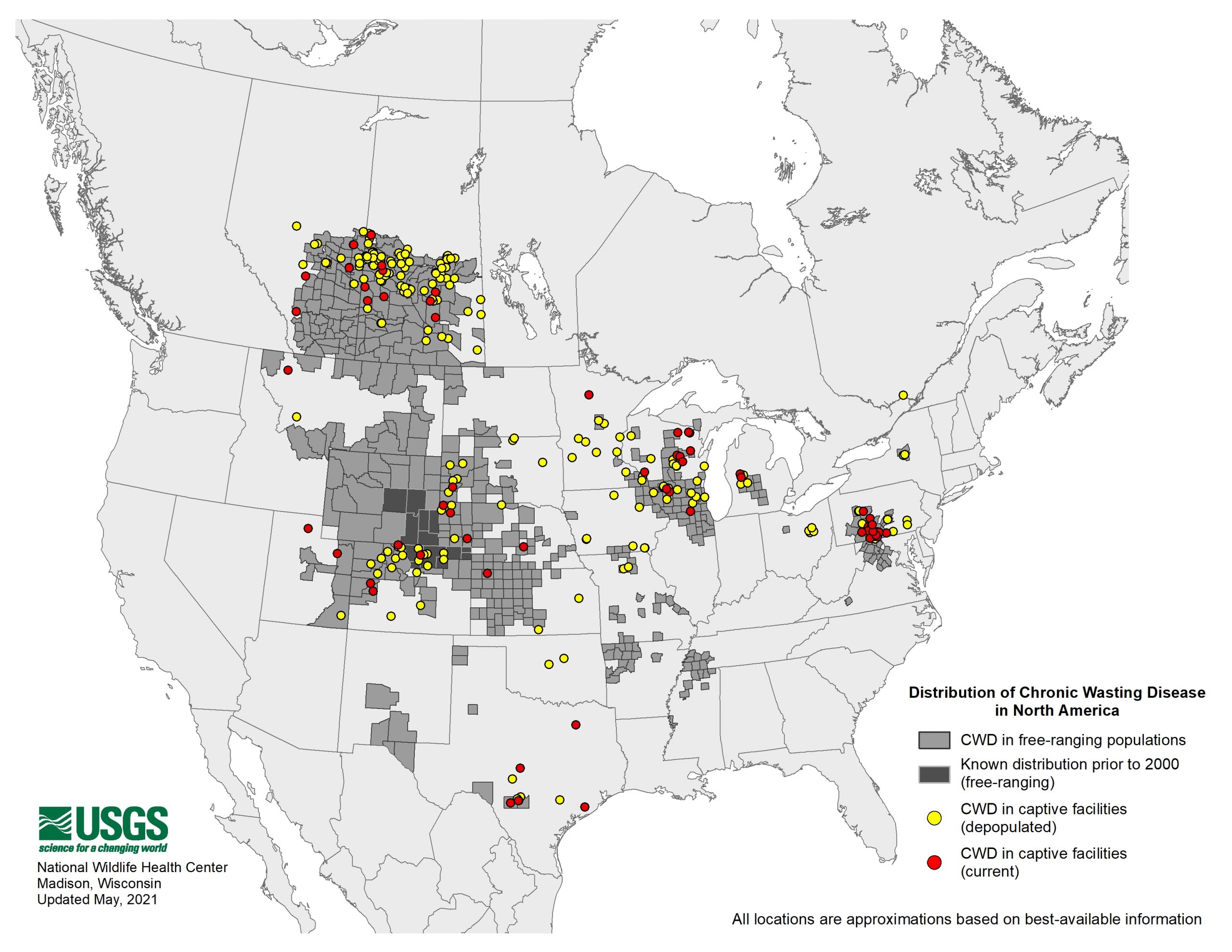
Distribution of CWD in North America, May 2021.
© Bryan Richards, USGS National Wildlife Health Center
Over 30 stakeholders and experts write to the federal government in the summer, warning of potential trade embargoes and health risks if the government fails to contain the disease, which receives widespread media attention. The National Fishing and Hunting Collaborative (containing fish and game organizations across the country) urge the federal and provincial governments to take action to meaningfully tackle CWD, and has listed is as a top priority in the upcoming federal election.
The Dene Nation raises concerns of the potential impacts of CWD if spread to remaining caribou populations.
Preliminary findings from a study of long-term exposure of CWD to macaques conducted at the University of Calgary indicated that those that were fed deer meat eventually developed symptoms of the disease. Health Canada and province recommend “avoiding consumption of foods from known infected or any diseased animals”.
The Canadian Food Inspection Agency (CFIA) declares the situation “out of control” in Alberta and Saskatchewan and pulls back from further attempts at eradication.
Test results from 2014 indicate 86 new cases of chronic wasting disease in 74 mule deer and 12 white-tailed deer. Alberta game farms continue to struggle with chronic wasting disease outbreaks, including in elk. The disease has recently been found in Hand Hills near Drumheller and in the Bow River drainage near Lake Newell. In 2014, it is further entrenching along the Alberta-Saskatchewan border.
Alberta Environment and Sustainable Resource Management release information regarding 2012 chronic wasting disease testing. Preliminary results confirm CWD in twenty-four cervids inclusive of 19 mule deer, 4 white-tailed deer and one moose. This marks the first detection of CWD in moose in Canada.
Updates to the Government of Alberta SRD website state that testing of heads from the 2010 fall hunting season is nearing completion. From September 1, 2010 to March 23, 2011, nearly 5062 wild deer heads were tested, and 19 (0.4%) new cases of CWD have been detected in wild deer in AB. This brings the total number of detected CWD cases in wild deer in AB since Sept. 2005 to 94. Of significance, one positive yearling mule deer buck was found in the North Saskatchewan River valley in AB, which is strong evidence of recent expansion of the disease into the valley.
In response to widespread public opposition to Bill 11, Agriculture Minister Jack Hayden assured the public that the province will amend the Bill to ensure no room is left for the establishment of hunting preserves. “We will be putting forward an amendment to clarify the position,” Hayden said. “There will be no hunt farms…That was the position of the government in 2002, and it has never changed, and it hasn’t changed today. There will be no hunt farms for deer or elk.”
AWA and our team of Wilderness Defenders act to oppose proposed amendments to the Livestock Diversity Act. These amendments would reclassify “domestic cervids” as “diversified livestock”. As well, Section 10.1 of this act would enable the Minister to authorize activities that “would otherwise constitute a contravention of this Act”. This gives the Minister of Agriculture the power to allow penned “hunting” of farmed deer and elk on Alberta game farms.
An Alberta government news release states that “…12 new cases, along with an emaciated deer found in June, bring the total to 13 new cases of chronic wasting disease found in 2009.” In early 2010, AWA had written to Minister Mel Knight to request an update to the government’s official website and source of information about CWD as it had not been updated since 2005. AWA received no response but checking the website, saw that it was updated in June 2010 and now states that “The cumulative total of confirmed cases of CWD in wild deer in Alberta is 75.”
In September, according to a study published in the journal Nature the infectious agent which leads to CWD (called prions), are spread in the feces of infected animals long before the animal even becomes ill. Fecal-oral transmission is very effective, and explains the high rates of transmission among deer. This research also indicates that prions have the ability to bind to clay in soil and may persist for long period of time. This means there is very little chance that CWD will ever be eradicated. No evidence exists to indicate the prion that causes CWD can pass naturally to humans.
In April, Alberta government was once again approached with requests to allow hunting on game farms. This request occurred in response to a general economic decline in the game farming industry since 2002. Resource Minister Ted Morton expressed he was not interested in allowing hunting on game farms, and suggested the industry would have to be more convincing.
Wild boars are declared pests by the province, legislation resulting from a year of consultation with municipalities and farmers throughout AB who have voiced concerns about boars. Wild boar populations are the result of escaped boars from game farms establishing reproducing populations.
Three cases of CWD found in wild deers in AB. AWA responds by, once again, asking the government to phase out wildlife domestication in AB by compensating game farmers.
AWA also calls for the establishment of a scientifically sound procedure to deal with CWD in wild deer populations, as we consider the current management plan of deer culling unacceptable.
In conjunction with staff from Saskatchewan Environment, limited herd reduction was conducted in AB. From 1439 deer collected in AB, CWD was confirmed in 7 wild deer along the AB-Sask. border.
More and more, the economic viability of the elk farming industry is being questioned. The value of breeding stock has plummeted, and elk-farmers are still shut out of the elk velvet market in the Far East due to CWD fears. To date, the fight against CWD in elk has cost $33 million to compensate farmers, mainly in Saskatchewan.
In August, the International Fund for Animal Welfare requested the RCMP expand its investigation into the alleged poaching of wildlife by game farmers. The call for immediate action came after new charges were laid in Canada’s largest poaching case in recent history. Saskatchewan veterinarian and game farmer John Phillip Murray faced 22 charges of fraud in provincial court for allegedly trapping and selling as many as 1,000 white-tailed deer over three years.
Premier Ralph Klein speaks out strongly against proposed penned “hunting”operations, describing them as “abhorrent”.
In August, AB elk and deer farmers lobby for amendments to provincial laws that would allow shooting in fenced enclosures of their domestic stock as a commercial venture. AWA, along with a coalition of hunting, conservationist, and animal rights interest groups, actively oppose such amendments. AWA considers such privatization and abuse of wildlife inhumane and unethical.
In January, Canada’s elk farming industry suffers a blow due to a Korean ban on imports of Canadian elk antler velvet. The ban was triggered by a BBC news story featuring the recent outbreak of CWD in Saskatchewan, where 14 positive cases on seven elk farms have been detected.
First report of Chronic Wasting Disease (CWD) in a wild mule deer in Saskatchewan. CWD is a fatal degenerative disease of the brain that affects elk, mule deer, and white-tailed deer. It is more likely to occur where elk and deer live in crowded corridors, such as game farms.
Soon-to-be Prime Minister Jean Chretien supports a public review of game ranching because “we agree that game farming has potentially wide-reaching implications that have never been subject to thorough public discussion”.
Dr. Valerius Geist, then professor of environmental studies and biology at the University of Calgary, warns it is inevitable that tuberculosis-infected elk will escape from captivity, and act as the “disease bridge” between livestock and wild animals. “We know animals are going to escape and mingle with those in the wild,” said Geist.
The Livestock Diversification Act is passed in Alberta. This Act transfers administration of game farming from Fish and Wildlife to Alberta Agriculture. The Act controls sale of breeding stock, meat and antlers, licensing, compulsory identification and registration of stock, fencing standards and monitoring of product to ensure no wild animals can be included.
Agriculture Canada orders the destruction of a 600-head, $1-million game herd after bovine tuberculosis was detected in two of animals. Moravia Breeding International Ltd., farm is located 70 km south of North Bay Ontario. Included in the herd slated to be destroyed are camels, deer, elk, bison, and a Siberian tiger.
The Board of Directors of the Canadian Nature Federation announces its opposition to big game ranching in Canada. CNF Executive Director stated he fear “the development of big game ranching could be the start of a trend toward private ownership of our wildlife rather than the public stewardship which currently exists.” These conclusions come as a result of a two-year in-depth study examining the controversial issue.
Currently there are 251 commercial game ranches and farms in Alberta, Saskatchewan, and Manitoba, holding 5100 bison and 2900 wapiti.
In January, the Division of Fish and Wildlife released the promised “White Paper” on game ranching. The document is considered lacking by AWA, and is basically 11-pages of game ranching “promotion”. The main issue- whether Alberta is well served by game ranching, and whether it should be part of our wildlife management- is not addressed.
“The greatest danger of game ranching is to preservation,” says Dr. Val Geist, University of Calgary professor in a Southern Alberta Environment Group meeting.
Agriculture Canada destroys 32 elk in the first Manitoba game farm, the Tent Town Game Farm near Minitonas, that were among 58 imported the year before from the U.S. John Eisner, owner intended to breed them with the hope of exporting their offspring. The animals have antibodies to the disease of blue-tongue, which is unknown in Canada. They are destroyed to defend Canada’s reputation as a country free of this disease, to insure that there is no danger to livestock in the area. The animals had been tested twice in the U.S. and the results were negative. However, later tests in Canada were positive. The government pays Eisner $3000 for each animal. Blue-tongue is fatal to sheep, an important animal in New Zealand’s economy.
Alberta is at a crossroads in wildlife management as Alberta’s associate minister of public lands and wildlife, Don Sparrow, attempts to railroad through legislation of a new wildlife act endorsing game farming. These attempts have been met with widespread public opposition from many Albertan’s. Representatives of the Alberta Fish and Game Association, Alberta Wilderness Association, and the recently-formed ESAU (Equal Shares for All Users) have united to oppose revisions to the Wildlife Act.
Game farming makes its debut in Canada.
Manitoba acquires its first game farm for elk in Spring. The objectives of the ranch are to sell elk meat, breed stock for sale to New Zealand and research into elk habits, such as food preferences, calving information, etc. The venture starts with 10 elk, one bull and nine pregnant cows, removed from a local native herd due to a lack of available animals from other sources. The proposal for the game farm is supposed to go through a public consultation process. However, due to an intervening election in which the file changed hands, only one public meeting is held before someone signs the go-ahead for the venture. Consequently, there are a number of problems that are not taken into account that are outlined by the Dept. of Natural Resources and various concerned groups.
“Vague policy and too little study before the decision has resulted in a major headache for all those concerned,” writes Lyle Fullerton in Western Canada Outdoors (Sept-Oct. 1982). “Alberta presently appears to be faring a little better, in that, no ranches are presently in operation. New policy and reorganization are underway, with the direction of Mr. Dennis Surrendi, Assistant Deputy Minister of the Fish and Wildlife Branch. A new department, “Commercial Wildlife” is being looked into with real interest….With a name like “Commercial Wildlife,” it is not too difficult to read between the lines and see a push toward the eventual sale of wild meat and/or products.” He notes that the Wildlife Act will have to be changed if big game products are to be sold.
“Policy in each province is desperately needed to ensure that true wildlife does not become a by-product of commodity activities, even when that commodity activity was once wildlife….An underlying emotional struggle is what many persons, including myself, appear to be going through as wild animals, such as elk, have been long thought of as a regal, majestic portion of our wildlife heritage. To allow the confinement and commercial selling of products would be a serious degradation of this animal’s reputation and out heritage. To ranch big game or not is a question we all have to ask ourselves. It affects each and every one of us no matter what lifestyle we are living. Does money have to be the centre of that lifestyle and is all of creation a potential monetary value which is only seen as a development away?”
B.C. proposes to launch an initial four game farms on private land for the first decade. Opposition is strong to the proposal, many concerned that game farming would be extended to public lands, which would interfere with the hunter’s domain.
Game ranching is defined by Telfer and Scotter, Journal of Range Management May 1975, as “the keeping of wild mammals, principally large ungulates, either in fenced enclosures or under close surveillance, so that efficient systematic harvesting of meat is possible. The animals thus kept in semi-domestication may be either exotic or native species, but “game ranching” usually refers to the latter.” Private ownership is not necessarily part of the definition.
The provincial government set up an interagency task force- the Alberta Wildlife Production Research Committee- to explore the potential of game ranching. It concluded that the practice was both economically and technically feasible as well as a good way to make existing marginal farms more viable.
End of the open wildlife market in North America. It is ended because of slaughter and close extinction of several species of wildlife. The North American system of wildlife conservation is implemented – wildlife is considered a public resource, it cannot be sold for profit and access to wildlife through hunting is controlled by law.
November 18, 2021
Wild Lands Advocate article by: Devon Earl, AWA Conservation Specialist Click here for a pdf…
October 4, 2021
Alberta Wilderness Association strongly opposes the proposal to legalize elk hunt farms – fenced facilities…
October 4, 2021
Please click the link below to view AWA’s comment letter addressing Alberta Environment and Parks’…
May 25, 2021
AWA is asking our federal and provincial governments to take action in the context of…
February 1, 2016
February 2016 Wild Lands Advocate article by Joanna Skrajny If you’ve grown up in Alberta…
July 12, 2013
Wild Lands Advocate update, April/May 2013, by Wonnita Andrus. In late March 2013, Alberta Environment…
March 19, 2013
Alberta Environment and Sustainable Resource Development (AESRD) released part of the 2012 Chronic Wasting Disease…
April 21, 2011
AWA participated in a press conference organized by the Lethbridge Fish and Game Association. In…
April 1, 2011
Wild Lands Advocate article, April 2011 by Madeline Wilson. “Once again, the provincial government has…
March 15, 2011
A letter from AWA to Premier Stelmach expressing concerns on recent proposed amendments to the…
December 1, 2008
Wild Lands Advocate article, December 2008, by Vivian Pharis. Chronic wasting disease poised to cross…
October 1, 2006
Wild Lands Advocate article, October 2006, by Shirley Bray. Study shows CWD may spread through…