


March 15, 2024
Action Alert: Bison must be listed as wildlife in Alberta
Designating bison as wildlife is long overdue. The current classification of a wild species as…

Often envisaged as the iconic wilderness animal of North America’s grasslands, the bison (Bison bison) population has faced near extinction from a once formidable population of approximately forty million in the seventeenth century.
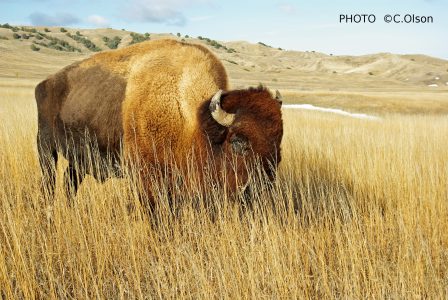
Plains Bison – Badlands ©C.Olson
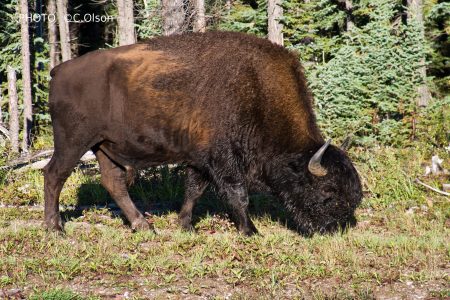
Wood Bison – Blachford Lake NWT ©C.Olson
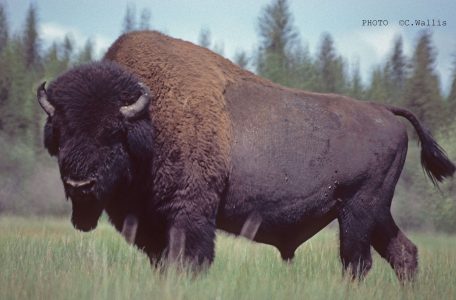
Wood Bison – Wood Buffalo National Park ©C.Wallis
AWA’s vision is for wild bison herds to remain wild and disease-free. While the conservation and recovery of bison in Alberta is complex, AWA believes bison need enough contiguous habitat to become self-sustaining and management strategies that support food security for Indigenous communities.
Bison are a keystone species to the prairie ecosystem, directly affecting plant composition and maintaining grasslands and meadows through grazing. Flooding and fires traditionally reduced the encroachment of forests to meadowed areas, providing bison with wet meadow sedge and grass vegetation that bison depend on. Historically, First Nations played a critical role in fire management to clear forests and renew grazing areas. Now, the management of flood and fires in the province has reduced disturbance regimes.
Bison played an important role in the disturbance regimes of prairie and woodland wilderness areas throughout central and northern North America historically. They also provided forage for large carnivores such as wolves, coyotes, and grizzly bears. Efforts are being made in Alberta and other jurisdictions to re-establish the role of bison as an ecological keystone species. Land use planners, First Nations communities and federal agencies are working to have Wood bison numbers grow. The range expands throughout the boreal ecoregion in northern Alberta. Wild Plains bison have been reintroduced to Banff National Park, and the Kainai Nation in southern Alberta. The Iinnii Initiative, a collaborative effort for the reintroduction of bison was launched by leaders of the four tribes that make up the Blackfoot Confederacy (Blackfeet Nation, Kainai Nation, Piikani Nation, and Siksika Nation) to conserve traditional lands, protect Blackfeet culture, and create a home for the buffalo to return to. Their initiative has brought together leaders and those concerned with advancing bison reintroduction across the provinces and states.
In Alberta, free ranging bison outside of specified Wildlife Management Units (WMUs) in northern Alberta are designated as “livestock”. Because they are not considered wildlife, they have no status under Alberta’s Wildlife Act. Within those specified WMUs across the north of the province, wood bison are listed as threatened under Alberta’s Wildlife Act. AWA believes wild herds must be managed as wild, and that Alberta needs a strategy to differentiate the status for wild bison and domestic bison based on ownership. AWA supports the reintroduction of extirpated species and continues to advocate for the protection of wild areas that will enable bison to persist as a self-reproducing population in Alberta. AWA believes reintroduction into Suffield National Wildlife Area with its vast prairie grasslands could be considered an important area for Plains bison to move throughout its historic ranges.
The status of both subspecies internationally, nationally and provincially as of November 2021 is listed in the table below.
| International status | National status | Provincial status in Alberta | Regional Status | |
| Plains bison |
|
|
Extirpated* | From Wild Species 2010: The General Status of Species in Canada:
|
| Wood bison |
|
|
* considered livestock; not listed under Alberta Wildlife Act
** only within specified Wildlife Management Units (WMUs) in northern Alberta. Free-ranging bison in the rest of the province are considered as livestock; and not listed under Alberta Wildlife Act
Wood Bison
Currently within Alberta, there is a total of six subpopulations of wood bison found within provincial public lands and federal lands, with accompanying population management strategies varying between herds. AWA does not support the down-listing of the wood bison from ‘threatened’ to ‘special concern’ under SARA.
Plains Bison
There are currently 3 subpopulations of plains bison residing within Alberta. AWA believes that wild Plains bison must be up-listed by SARA to ‘endangered’ from extirpated.
Dramatic conservation measures were undertaken in the early part of the twentieth century to give bison a chance to survive, but the species continues to face many of the same threats that have caused their numbers to decline for the past 300 years.
A large part of Plains bison’s original range has been converted to agriculture or urbanized since European settlement. Habitat loss and fragmentation remains the greatest threat to bison conservation. Plains bison only occupy 0.5% of the historical range in Canada. Two major disturbance regimes, fire and flooding, have been absent or severely suppressed in the traditional range of bison, especially in northern Alberta. Fires were intentionally set by First Nations peoples to move herds, clear forests and renew grazing areas. Past fire suppression practices of resource management agencies throughout the province have caused the encroachment of forests onto meadow areas. Flooding was an equally important disturbance vector in northern Alberta along major waterways such as the Peace River, as it pushed back forests and renewed the wet meadow sedge and grass vegetation that bison depend on. Dam building, specifically the W.A.C. Bennet dam in British Colombia, has regulated flows for much of the Peace River Valley downstream and removed flooding from the landscape.
Tuberculosis and brucellosis are introduced livestock diseases that have been transmitted to some Wood bison herds. Anthrax, a bacterial disease, was a major cause of death for wood bison before 1978 and is also a threat: in a recent event, the Mackenzie herd decreased by 53% due to an outbreak of anthrax. In the Alberta Wildlife Act, diseased bison are considered non-wildlife and are not protected. In the legislation, “bison east of Highway 35 are assumed diseased and have been classified as non-wildlife.” COSEWIC has stated that populations have increased; however, their assessment does not consider that WBNP herd is not considered wildlife in Alberta. Discounting the large number of wild Wood bison that are present in the WBNP population significantly reduces the Canadian population and should be taken into consideration by COSEWIC. Until the WBNP herd are once again considered wildlife under the Alberta Wildlife Act, AWA does not support the down-listing of Wood bison.
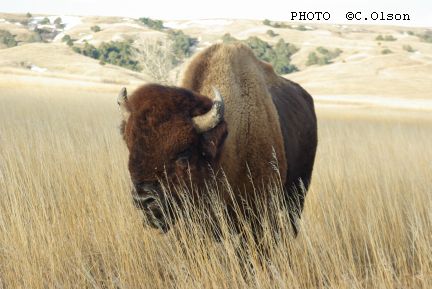
Pains Bison © C.Olson
The Ronald Lake herd located southeast of Wood Buffalo National Park was tested between 2010 and 2014 and found to be disease-free. However, because the Ronald Lake herd is outside of Wood Buffalo National Park and east of Highway 35, it is not classified as wildlife. This caused controversy when poaching occurred in 2015. However, an amendment in 2016 in the Wildlife Regulation ensured the Ronald Lake herd receives the same protective status as non-game animals.
Like most wildlife, human-caused mortality from roads presents a severe threat to the viability of population growth, historical range restoration and landscape connectivity. For example, in a 2001 study, the Hay-Zama herd faced more mortality from vehicle collisions than predation and other natural causes combined. Further, bison outside the special management zone are not considered ‘wildlife’ by the provincial government, meaning bison fall through the cracks of legislated protection when they range freely and despite the endangered status of this animal, there are still legal hunts that do not even require a hunting license.
The Reintroduction Plan for Plains Bison in Banff National Park was released in March 2015 by Parks Canada agency. The plan targets a maximum of 600-1000 individuals, starting by introducing a herd of 30-50 disease-free animals from Elk Island National Park to the Panther and Dormer rivers in the east-central portion of the park, by winter 2017.
AWA is concerned about the following issues regarding the reintroduction into BNP:
The majority of Plains bison are privately owned, and legally considered livestock. The COSEWIC 2013 Assessment and Status Report on bison states, “People involved in the commercial bison industry own approximately 97.4% of all bison in Canada.”
A strategy in Montana maintains a dual status for wild bison and domestic bison based on ownership. Their status depends on whether they are located on a commercial farm, a private conservation herd or in the wild. A similar strategy must be adopted in Alberta. Tools such as GPS collars for reintroduced herds will assist in their management. As well, education and awareness programs are necessary for reducing risks to visitors in reintroduced areas.
COSEWIC 2013 names 1,200-1,500 Plains bison and 5,136-7,172 Wood bison wild mature individuals in Canada (Plains bison can be found in BC, Alberta and Saskatchewan; Wood bison can be found in Yukon, NWT, BC, Alberta and Manitoba). From the last census completed in 2011, there are 57,430 farmed bison in Alberta. COSEWIC does not consider the 10 conservation herds in Canada as ‘wild by nature’ as they are used for educational purposes and managed intensively.
In British Colombia and Saskatchewan, Plains bison are protected from unregulated hunting under each province’s Wildlife Act. Alberta and Manitoba consider Plains bison to be domestic animals.
Two subspecies of bison have historically existed in Alberta: Plains bison (Bison bison bison) and Wood bison (Bison bison athabascae). There is ongoing debate as to the viability of treating Plains bison separately from Wood bison in management and status. AWA defines ‘wild’ bison as that which has not been subject to gene introgression through breeding with cattle.
Bison are the largest terrestrial mammal in North America and live on average 15 years in the wild, but Plains bison can live up to 30 years, and Wood bison can live up to 40 years. Bison have low fecundity with males usually breeding at age 3 and females calving a single offspring at age 2.
Bison are grazers, preferring wet meadows in the boreal eco-region and grassy areas of the prairies, occupying a unique niche among North American herbivores. First Nations people played an important role in the maintenance of high quality range areas for bison through the use of fire.
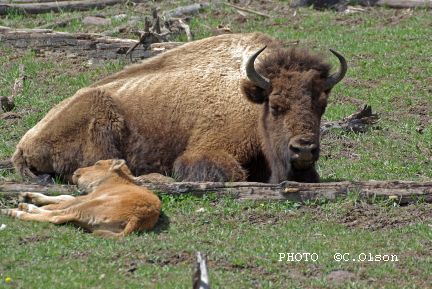
Cow and Calf Bison ©C. Olson
Prior to European settlement, an estimated 30 million bison roamed the continent. By 1888, populations were decimated leaving only 85 Plains bison in North America. Population declines were a result of:
Plains bison: occurs in only five isolated wild subpopulations in Canada, with one wild Plains bison herd of around 450 individuals in Elk Island National Park. There are 1,200-1,500 wild mature individuals in Canada, occupying less than 0.5% of original range.
Wood bison: 3,536 bison (2,828 in the wild) free of disease. There are six subpopulations of Wood bison in Alberta: Wood Buffalo national Park; Elk Island National Park; Ronald Lake; Wentzel/Wabasca; Hay-Zama; and Etthithun. There are 5,136-7,172 wild mature individuals in Canada.
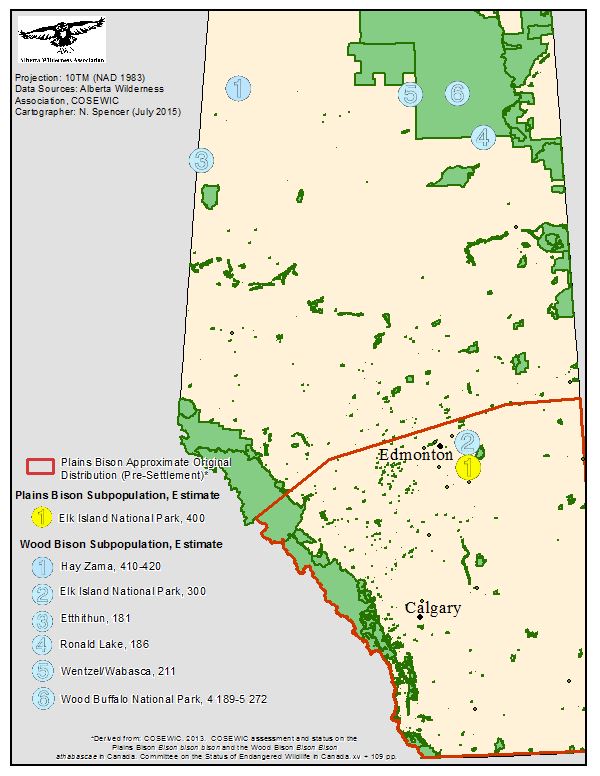
Map of Alberta bison populations and historical distribution of Plains bison
AWA, along with several other environmental organizations, wrote to the Alberta Minister of Environment and Protected Areas, Rebecca Schulz, and Minister of Indigenous Affairs, Rick Wilson, asking bison to be listed as wildlife. Plains bison and wood bison outside of designated areas are still considered livestock and lack protections.
In November 2021, the Government of Alberta amended the Alberta Wildlife Act to finally designate wood bison as a Threatened species, and thus formally acknowledging wood bison as wildlife for the first time in our province. Until this amendment came into force, wild populations of wood bison were only considered as livestock and not legally recognized as wildlife in Alberta.
Under this amendment, wood bison are considered Threatened within specified Wildlife Management Units (WMUs) across the northern part of the province – one of which was newly created under this provision. A Threatened listing affords these WMU populations protection from hunting by anyone other than those with Indigenous and/or Treaty hunting rights.
AWA are encouraged to see these necessary changes being made to Alberta’s archaic Wildlife Act and we hope that this signals renewed intent from the Government of Alberta to pursue ongoing and meaningful actions in the protection and recovery of wood bison populations in our province.
In June, Canada and Alberta issue a draft Conservation Agreement for the Wabasca and Ronald Lake Bison Herds for public comment. AWA supported the proposed active role for Indigenous Peoples in the conservation, recovery and management of the two herds. For Ronald Lake, we requested more stringent management of industrial leases and stronger commitments to secure and/or restore important habitat areas. For the Wabasca herd, we urged Alberta to promptly end unregulated hunting.
On February 19, six plains bison from Elk Island National Park arrived at Waterton Lakes National Park bison paddock. Blackfoot Elders from Kainai Nation, Piikani Nation and Siksika Nation welcomed the bison back to the park, blessing the animals and the land in a private prayer ceremony. In 2017, the Kenow Wildfire forced the removal of the bison until now, when the range has recovered from the fire and can support the bison.
On February 17, the Ronald Lake Bison Herd Cooperative Management Board convenes its first meeting. The board comprises membership from First Nations, Métis, the provincial and federal government, and resource industries, with AWA being the sole ENGO representation. The Board is to provide advice relating to the sustainability of the herd, including sustainability of Indigenous traditional use of and connection to the herd.
On February 12, plains bison are rematriated by the Blood Tribe to serve as the foundation of the Kainai Herd.
In spring, ten new bison calves are born into the herd in the Upper Red Deer River Special Bison Area; since 2017, the herd’s numbers have nearly tripled.
In February, fourteen wood bison are translocated from Elk Island National Park to the Woodland Cree First Nation about 500 km to the northwest, as part of Elk Island’s bison conservation program. This is done to reduce pressure on the park’s grasslands from grazing, and to simulate natural selection. The move is also undertaken as an act of reconciliation: bison were once native to the area around Woodland Cree First Nation but have not populated the area for nearly a century. The future plans for the herd include ongoing breeding, combined with traditional harvest. This is part of a broader translocation program that also sees bison moved to other nations, such as the Poundmaker and Onion Lake Cree Nations, throughout 2020 and 2021.
In January, the federal environment minister issues a finding of Imminent Threats to Recovery of the Wabasca and Ronald Lake wood bison populations. The imminent threat cited for Wabasca is unregulated hunting, with less than 20 individuals remaining. This population remains in very grave danger of extirpation. The imminent threats to Ronald Lake bison are cited as contracting bovine diseases from Wood Buffalo National Park bison, and range loss from proposed industrial activities. With a February 2020 decision by Teck Resources to withdraw its proposed mine, Ronald Lake bison receive a much-needed reprieve from their largest looming danger, but much more remains to be done to secure this population.
Alberta Wilderness Association chairs the Great Plains Conservation Network (GPCN) which has a Bison Working Group. “This working group includes GPCN partners across the plains engaged in bison restoration and large-scale prairie habitat protection. Efforts by committee members include promoting collaboration with Native American tribes with established conservation or cultural herds, national parks with bison as wildlife, the American Prairie Reserve and other partners with a high potential for bison restoration and an increased awareness of the importance of recognizing bison as wildlife. The Bison Committee supports the development of a strategy to establish a network of prairie reserves across multiple states from Mexico to Canada, where additional bison conservation herds could be established. The Committee is also engaged in cooperative efforts for creating a program for the translocation of bison from Yellowstone National Park—animals of high genetic value—to conservation herds on tribal and public lands across the Great Plains.” (GPCN website, 2020)
In August, AWA meets with provincial wildlife managers to express concerns about the most vulnerable wood bison populations. Over the following months, AWA publicly urges the federal government not to approve Teck Resources’ Frontier Oil Sands Mine due in part to the significant areas of the Ronald Lake bison range that the mine would destroy.
In December, the Government of Alberta announces plans to create a Ronald Lake Bison Herd Cooperative Management Board. AWA accepted the opportunity to sit on this Board. The Board is to provide advice relating to the sustainability of the herd, including
sustainability of Indigenous traditional use of and connection to the herd. The projected start date for the Board to convene is February 2021.
In August, the federal government publishes a final Recovery Strategy for wood bison. Due to insufficient information the recovery strategy does not identify any critical habitat for this species of bison. The critical habitat identification timeline, previously ending in 2021, has now been extended to 2023. The recovery strategy promises that one or more action plans for Wood Bison “will be completed by 2022.”
In Alberta, listed bison are only found in the Bison Protection Area in northwestern Alberta and the part of northeastern Alberta approximately between Birch Mountains Wildland Provincial Park and Wood Buffalo National Park that is home to the Ronald Lake herd. In the former area it is illegal to hunt, harm, or traffic in bison without a licence; hunting of the Ronald Lake herd in the aforementioned part of northeastern Alberta is closed until further notice.
On August 1, the Government of Alberta creates the Upper Red Deer River Special Bison Area to serve as a buffer area for free-roaming plains bison. Located approximately 60 km west of Sundre, the Upper Red Deer River Special Bison Area totals over 239 km2, fully encompassing the Ya Ha Tinda Ranch, allowing wildlife officers to protect and redirect bison that may have veered too far from home.
In February, in early February, a plains bison herd of 16 individuals is reintroduced to a “soft-release” pasture in Panther Valley in Banff National Park. The herd is expected to stay for 16 months and in the summer of 2018 released into a 1,200km2 area on the eastern edge of the park.
In January, Parks Canada responds to AWA’s letter with an addendum and summary of changes to the DEIS. AWA is pleased to see some of our feedback incorporated. Particularly, Parks Canada commits in the DEIS to “adhere to the existing Park Management Plan direction regarding minimal facility development and limited commercial opportunities in order to maintain the wilderness character and high ecological values present in the East Slopes area.” Other feedback from the addendum includes:
“Parks Canada will conduct targeted surveys for rare and sensitive plants in the reintroduction zone in 2017″; “Parks Canada proposes to conduct this pilot project with a commitment to ongoing performance assessment and an in-depth 5 year evaluation to determine the feasibility-of and goals for longer-term bison restoration”; “Parks Canada continues to work closely with Alberta provincial counterparts to ensure there is agreement on how to manage bison in transboundary areas.”
In November 2016, the Banff Bison Reintroduction Project’s Detailed Environmental Impact Assessment comes out for public comment. If the project receives public support, 12 pregnant two-year old cows and 4 two-year old bulls will be introduced to an 18-ha, enclosed ‘soft-release’ pasture in February 2017. Calving is known to bond bison to a particular place so they will be less likely to escape.
In July, the USDA National Park Service releases the Bison Resource Stewardship Plan Environmental Assessment for Badlands National Park, North Unit. The purpose of the plan is to expand the geographic bison range. Many environmental non-governmental organizations, including the World Wildlife Fund (WWF), support the initiative.
AWA submits comments on the Wood Bison Recovery Strategy.
In June, a draft Recovery Strategy for Wood Bison comes out for public comment. The strategy proposes a short term objective to maintain disease-free status, population size, and range of all disease-free Wood Bison local populations, while the long term objective is to ensure the existence of at least 5 disease-free, genetically diverse, connected, self-sustaining, free-ranging local populations distributed throughout their original Canadian range. The objectives will not be achieved until population levels are sufficient to sustain traditional Aboriginal harvesting activities, consistent with Aboriginal and Treaty Rights of Aboriginal peoples of Canada.
In April, the Ronald Lake bison herd is now recognized as a Subject Animal under the Wildlife Regulation. This means the herd receives the same protection under the Wildlife Act and Regulation as Non-Game Animals.
In March, Montana’s Blackfeet reservation near Glacier National Park and Badger-Two Medicine wilderness receives a bison herd from Elk Island Park.
“Rewilding” efforts continue outside of North America: a group of 11 European bison are reintroduced into state forests in the Netherlands. Herds also exist in Poland and Romania.
In February, Conservation groups take different positions on the reintroduction of bison to Banff National Park. AWA remains concerned about the use of fencing, management of bison roaming outside of the park and the associated issues of inter-breeding with domestic cattle and spread of disease, and the potential for increased commercialization of Banff National Park.
In October, AWA writes to Environment Canada urging the ministry to list Plains Bison as Threatened under Schedule 1 of Species at Risk Act, as well as urging Wood Bison not to be down-listed to Special Concern.
In July, an anthrax outbreak kills 53 bison in Wood Buffalo National Park. Anthrax outbreaks have occurred a dozen times since the 1960s.
In March, Parks Canada publish a Reintroduction Plan for bison in Banff National Park with a vision to “restore a wild, free-roaming bison population to Banff National Park in a way that supports ecosystem integrity, enriches and is compatible with other visitor experiences, facilitates cultural connections with the landscape and wildlife, and enhances learning and stewardship opportunities, both in the park and from afar.”
In February, a population study conducted in the Hay-Zama herd found 501 individuals. This is between the 400-600 herd size objective of the Alberta government, meaning a hunt can continue this year.
In December, the Hay-Zama herd 2013/14 hunt is suspended as a result of severe winter weather, which caused unusually high calf and adult bison mortality.
In June, according to an annual Progress Report, Alberta’s management of bison in northern Alberta continues to focus on minimizing the spread of tuberculosis and brucellosis from wild bison to domestic cattle. Long term, the plan is, apparently, to eliminate the disease risk, which would “allow the restoration of wild populations of wood bison across northern Canada.” Between 2009 and 2013 521 bison are killed from the Hay Zama herds, all of which were free of tuberculosis and brucellosis.
In April, the Athabasca Chipewyan First Nation propose a “Co-Management Plan” that would see the establishment of two “zones” – a Protection Zone and a Stewardship Zone – within ACFN homelands in northeastern Alberta, aimed at the protection and restoration of bison and caribou habitat. “The primary goal of the newly proposed strategy is to ‘provide a concrete vision and tool for sustaining the way of life of our Nation, particularly in relation to ACFN Homelands, and in the face of anticipated or proposed development.’ This includes proactive protection and restoration of habitat for all local populations of caribou and bison within their historical range in ACFN Homelands.”
In March, IUCN releases report, American Bison: Status Survey and Conservation Guidelines 2010, on the current status of American bison, in the wild and in conservation herds, and makes recommendations on how to ensure that the species is conserved for the future. “Although the effort to restore bison to the plains of North America is considered to be one of the most ambitious and complex undertakings in species conservation efforts in North America, it will only succeed if legislation is introduced at a local and national level, with significant funding and a shift in attitude towards the animal,” says Dr Simon Stuart, Chair of IUCN’s Species Survival Commission.
In spring, a spring hunting season is brought in for the Hay Zama bison herd to “stop the Hay Zama herd from continuing to increase in numbers and distribution.” The intention is to prevent the “disease-free” herd from mixing with other herd known to be infected with tuberculosis and brucellosis.
In April, Aboriginals discover two kill sites in Caribou Mountain Wildland Provincial Park. It appears the animals were killed as trophies, as the heads and hides had been removed, but the meat was left to rot.
On July 4, two men are fined a total of $17,000 in provincial court in relation to the poaching of a bison calf in the Hay-Zama area.
In December, American Prairie Foundation, in cooperation with World Wildlife Fund, release 16 bison on a portion of 32,000 acres in the prairie south of Malta, Montana. This area is the core of their new prairie reserve, intended to restore native wildlife, including genetically important bison. This is one of the few wild herds free of any bison-cattle hybrids, and free from brucellosis.
In August, Federal Environment Minister, Stephane Dion, refuses to list plains bison to the list of species protected under the Species at Risk Act, despite a recommendation in May 2004 by the Committee on the Status of Endangered Wildlife in Canada (COSEWIC) to do so. Only around 8,000 genetically pure plains bison still exist, mostly in the U.S and at Elk Island National Park. AWA believes that economic interests were given undue weight in the decision not to list plains bison; effectively the interests of a handful of bison farmers are being put ahead of the interests of an endangered native species.
Since 1971, disease free populations have increased 1000% to 4800 animals, while the originally re-introduced herd in Wood Buffalo National Park has declined 80% to 2900.
In June, the Committee on the Status of Endangered Wildlife in Canada (COSEWIC) recommends that the Plains bison should be added to the list of species protected under the Species at Risk Act. Marco Festa-Bianchet, chair of COSEWIC, comments that it is important to “redouble our efforts to protect species at risk and their habitats.”
The government amends the Public Lands Act to allow commercial bison grazing on public lands.
Alberta Government lists bison as ‘At risk’ by the Fish and Wildlife Division and are legally designated as ‘Endangered’ by the Wildlife Act.
The Heart Lake Band in east-central Alberta receives 53 bison from Elk Island National Park to begin the restoration of ecological and cultural processes associated with bison.
The government holds multistakeholder meetings with several groups to determine whether commercial bison should be allowed to graze on public lands.
COSEWIC re-assess the status of wood bison and maintains the ‘Threatened’ status. Alberta government launches an initiative to increase commercial production of bison in the northwest of the province. Bison farms are increasing at a rate of 15% a year with commercial populations increasing at a rate of 25% a year. Present commercial population is over 20,000 bison.
Alberta establishes the Bison Management Area in a buffer around the Hay-Zama complex. Bison in this area are protected from hunting.
Hay-Zama herd established to create a disease-free, free-ranging population in Alberta in conjunction with the Dene Tha’ First Nation. Herd has expanded from 29 to 49 by 1993 and over 200 by 2001.
Lyle Fullerton writes (Western Canada Outdoors, Sept.-Oct. 1982): “Alberta presently has numerous bison farms, utilizing animals for the production of meat. Some of these ventures have realized “paid fee hunting” as another source of income. I guess if you have $3500 – $5000 laying around, you can enjoy a quiet “hunt” of a domestic animal in the seclusion of electrically confined enclosures….The decision was made some time ago that now that we have bison farms and these animals just don’t like to have a fence come between themselves and other farmers crops, they should be taken out of the Wildlife Act and be called domestic animals. The depredation budget operated by the Fish and Wildlife Branch no longer takes a beating when these animals get loose. had the decision been made to have the owners entirely responsible for his animals actions in the first place, the bison would not have been degraded to the level of a hereford beast. Will the same thing happen to elk, moose or deer, what next? Who will now take over registration and administration of the Boone and Crockett records in Western Canada? The department of agriculture? Hereford cattle may make it into the record book yet!”
Farming, including commercial bison operations, expand throughout Alberta and to within 70km of Wood Buffalo National Park.
21 bison from Wood Buffalo National Park are moved to Elk Island National Park and, after some disease management, the herd continues to grow successfully.
18 bison of the newly discovered herd are shipped to the western end of Great Slave Lake where a bison sanctuary is established. Herd expands successfully over subsequent years and becomes the largest free-roaming herd of wood bison in North America to the present day.
An isolated, hence disease free and genetically local, population of wood buffalo are found in a remote area of Wood Buffalo National Park.
Wood Buffalo National Park herd approximately 12,000. Diseases and genetic dilution of local stock are causing concern among conservationists.
6673 Bison transferred from Buffalo Park to Wood Buffalo National Park. Immediately 400 bison break away from larger herd and migrate to the Sweetgrass area. The park is expanded to encompass this area. Introduced bison outnumber remnant population 4:1.
Canadian government buys 709 bison from a Montana rancher and ships them to Elk Island National Park and eventually to Buffalo Park near Wainwright Alberta.
Wood bison population reduced to a remnant herd of 250 near Great Slave Lake.
Estimated plains bison population less than 1,200 in all of north America
Massive declines in bison numbers and range. Causes are clear, including intentional extermination by the US Government, over hunting and human settlement.
Estimates of 2-60 million bison exist throughout North America. In addition, an estimated 168 000 wood bison range from the present northern Alberta, north-eastern British Columbia, southern Yukon, the interior of Alaska and the south-western Northwest Territories.
March 15, 2024
Designating bison as wildlife is long overdue. The current classification of a wild species as…
March 15, 2024
Free-ranging bison, apart from in a few specialized regions, are still considered livestock in Alberta….
November 1, 2023
On November 1, AWA wrote to the Minister of Environment and Protected Areas, requesting a…
August 8, 2023
Alberta Wilderness Association has written to the Honourable Rebecca Schulz, Minister of Environment and Protected…
August 17, 2022
Alberta Wilderness Association (AWA) has co-signed a joint letter submitted by CPAWS Northern Alberta on…
August 11, 2022
Wild Lands Advocate article by: Phillip Meintzer, AWA Conservation Specialist Click here for a pdf…
January 25, 2021
Wild Lands Advocate update by: Karsten Heuer Click here for a pdf version of the…
December 2, 2020
Indigenous communities and environmental organizations say more action is needed Edmonton, AB – The ongoing…
December 2, 2020
Letter to the Director of UNESCO’s World Heritage Centre concerning Wood Buffalo National Park: December…
October 26, 2020
Wild Lands Advocate update by: Christyann Olson, AWA Executive Director Click here for a pdf…
November 23, 2019
AWA urges the federal government to reject Teck’s Frontier mine proposal, in a letter submitted…
March 11, 2019
Permanent protection over a significant area of lands south of Wood Buffalo National Park that…